
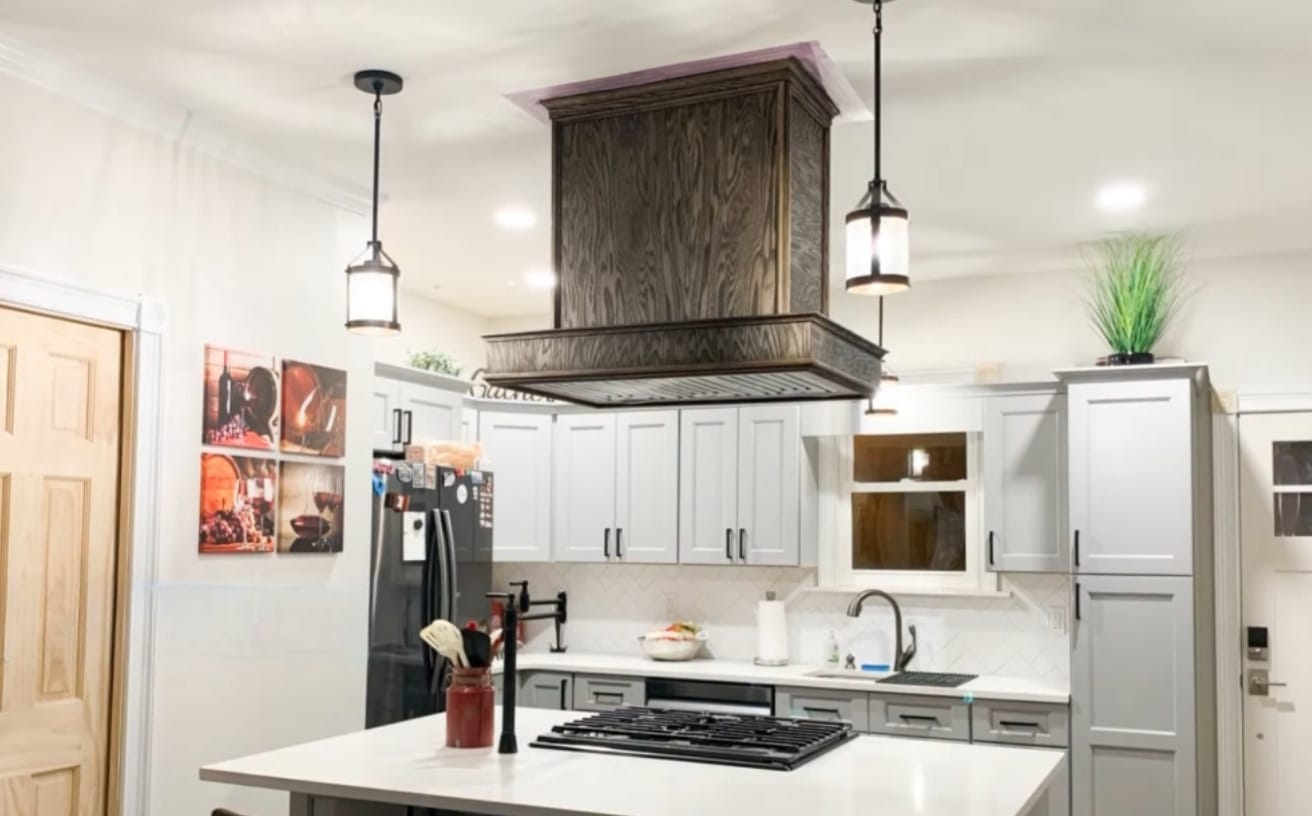
You have an island cooktop in an open-plan kitchen and you need a hood that works above it. In this guide, we cover the specific sizing, CFM, and installation factors that apply only to island hood installations. Knowing how to choose an island range hood is a different exercise than choosing any other hood type. The open position changes everything from how much CFM you need to what your ceiling has to support before you buy.
Why Island Hoods Require a Different Buying Approach
An island hood installation is not a wall mount installation moved to the center of the room. The physics are different, the structural requirements are different, and the sizing rules are different. Buyers who treat an island hood purchase the same way they would treat a wall mount purchase consistently end up with a hood that underperforms, looks wrong in the space, or creates installation problems that could have been avoided.
The core reason is exposure. A wall mount hood has a wall and backsplash behind the cooktop that funnels the rising cooking plume into the capture area. An island hood has nothing behind it. Air moves from all four directions, which means cross-drafts from HVAC vents, ceiling fans, foot traffic, and open windows actively compete with the hood’s suction. The hood has to work harder to capture the same cooking output, which is why island hoods require more CFM, wider canopies, and more installation planning than their wall mount equivalents. Getting those decisions right starts before a model is compared.
Know what your layout actually requires before you start comparing models.
Related Reading: Wall-Mount vs Island Hood: Which Do You Need?
Size Up Your CFM for an Island Installation
CFM is the most important specification in any range hood purchase, and in an island installation it is the one buyers most commonly get wrong. The standard CFM rules that apply to wall mount hoods do not apply directly to island hoods. The open, exposed position requires a meaningful CFM premium to deliver equivalent capture performance. In our experience, it is the step buyers skip most consistently and the one that produces the most avoidable underperformance.
CFM by Cooktop Size
The baseline CFM guideline for a wall mount hood is 100 CFM per linear foot of cooktop width for electric and induction, and 1 CFM per 100 BTU for gas. For island hoods, add 25 to 30 percent to those figures to compensate for the 360-degree draft exposure.
For a 30-inch electric cooktop on an island, that means a minimum of 375 to 400 CFM, up from the 300 CFM open-canopy baseline. For a 36-inch electric cooktop, most practitioners use 400 CFM as the practical wall mount minimum, sized up from the 300 CFM formula baseline. Apply the same 25 to 30 percent island premium to that practical figure: plan for 500 to 520 CFM. For a gas range with 40,000 BTU combined output, the wall mount minimum of 400 CFM becomes 500 to 520 CFM in an island position.
These are minimums. If your kitchen has active HVAC vents near the island, a ceiling fan above the cooking zone, or significant air movement from an open floor plan, sizing up further is the better call.
CFM and Ceiling Height
Most island hoods are mounted higher above the cooktop than wall mount hoods, partly because the open position allows it and partly because a higher mounting height reads better proportionally in a tall-ceilinged room. The standard mounting range for island hoods is 28 to 36 inches above the cooktop. Mounting at the higher end of that range, or above it for rooms with ceilings above 10 feet, reduces capture efficiency because the rising cooking plume disperses more before reaching the canopy.
If your ceiling height pushes you to mount the hood 36 inches or more above the cooktop, size up your CFM target accordingly. A hood mounted at 36 inches needs more suction than the same hood mounted at 28 inches to capture the same cooking output.
High-BTU Gas Ranges on an Island
A high-BTU gas range on an island is the most demanding ventilation scenario in residential kitchen design. Combined burner outputs above 60,000 BTU, common in semi-professional and professional crossover ranges, require at least 600 CFM in a wall mount position and 750 to 900 CFM or more in an island position. If your range falls into this category, treat the CFM requirement as non-negotiable. An undersized hood on a high-output gas island range will not keep up regardless of how new the filters are.
Match Hood Width to the Overhang Rule
Hood width determines how much of the cooking plume the canopy intercepts, and in an island installation it matters more than in a wall mount setup because there is no wall funneling air toward the hood from behind.
The rule for island hoods is to go at least 6 inches wider than the cooktop, 3 inches of overhang on each side. For a 30-inch cooktop, that means a 36-inch hood. For a 36-inch cooktop, that means a 42-inch hood. This overhang extends the capture envelope past the outer burners, where grease and steam are most likely to escape laterally before rising into the canopy.
The 30 vs 36 island range hood question comes up regularly among buyers who are hesitant to size up. In our experience evaluating island hood coverage across different configurations, the 36-inch hood over a 30-inch cooktop is consistently the better performing specification.
The additional 3 inches of overhang on each side has a real impact on front and side burner capture, and the visual difference over a standard kitchen island is smaller than most buyers expect before installation.
Do not match the hood width exactly to the cooktop width in an island installation. It is the single most common sizing mistake in choosing an island range hood, and one of the easiest to avoid.
Confirm Ceiling Bracing Before Purchasing
An island hood suspends from the ceiling with no wall support. That ceiling connection carries the full weight of the hood, the chimney flue, and the sustained vibration load of the fan motor over years of use. Confirming that your ceiling structure can handle this before purchasing is not a step to skip. It determines whether the installation is safe and code-compliant.
Most island hoods weigh between 50 and 120 pounds depending on size and material. The chimney flue adds additional weight. Standard ceiling drywall attached to joists is not adequate for direct mounting. The hood requires solid blocking or a structural support framework installed between ceiling joists before the mounting hardware can be attached.
In many homes, this blocking can be added by a carpenter or contractor without requiring a structural engineer. For larger, heavier hoods, homes with older or non-standard framing, or installations in multifamily buildings where structural modifications require approval, consulting a structural engineer before purchasing is the right call.
Factor the ceiling bracing work into your installation budget before you commit to a model. For a standard residential build without structural complications, ceiling bracing for an island hood typically adds $150 to $400 to the project in most markets, though contractor rates vary by region. Discovering the need for it after the hood is delivered is an avoidable problem.
Plan the Duct Path Through the Ceiling
Island hood ductwork does not run through a wall. It runs vertically through the ceiling flue and then horizontally through the ceiling plenum to an exterior exit point. That path introduces complications a wall mount installation does not have, and understanding them before you buy helps you budget and plan accurately.
The duct travels up through the ceiling and then needs to navigate whatever is in the ceiling cavity above: floor joists from the story above in a two-story home, HVAC ducts, electrical runs, and structural framing. In a single-story home with attic access above the kitchen, the path is usually more easy. In a two-story home, routing the duct horizontally through floor joists to reach an exterior wall can require significant framing work.
Duct diameter is also more critical in an island installation. Island hoods with CFM ratings high enough to handle the open position typically require 7-inch or 8-inch round duct. Every horizontal run, every direction change, and every foot of duct length reduces effective CFM at the hood. The duct path should be as short and direct as possible, and it should be confirmed before the hood is purchased.
If your ceiling configuration makes a clean duct path difficult or expensive, factor that into which model you choose and whether a professional installation consultation before purchase is worth the cost.
Account for Visual Proportion and Kitchen Scale
An island hood is visible from every angle of an open-plan kitchen. It needs to look right in the space as well as perform correctly above the cooktop. Proportion errors in an island installation are expensive to correct after the fact.
The hood body should be at least as wide as the island cooktop, and 6 inches wider is the better specification for both performance and visual balance. A hood that is narrower than the cooktop looks undersized from every angle and will also underperform.
The chimney flue length matters as much as the hood width. In rooms with standard 9-foot ceilings, a typical chimney extension fills the vertical space adequately. In rooms with 10-foot or higher ceilings, a short chimney flue above the hood body looks truncated and out of proportion.
Confirm that the model you are considering offers a chimney extension range that fills the space from hood top to ceiling cleanly at your ceiling height, and check whether extension kits are available if your ceiling falls outside the standard range.
The wider the island and the taller the ceiling, the more presence the hood needs in both canopy width and chimney height to read as intentional rather than undersized.
Choose Ducted Over Ductless in an Island Position
Ductless operation in an island position is the least effective ventilation configuration in residential kitchen design. We recommend against it for any kitchen where regular cooking occurs, and it is worth understanding why before dismissing that position.
In a wall mount installation, a ductless hood at least benefits from the wall funneling some of the cooking plume into the capture area. In an island position, there is no such assistance. Cross-drafts from all four sides reduce capture efficiency, the charcoal filter saturates faster, and recirculated air containing heat and humidity returns to an open kitchen with no natural boundary to contain it.
Ductless is acceptable in an island position in one scenario: when exterior venting is actually impossible and the cooking load is light. Reheating, occasional boiling, low-heat prep work. If that describes your actual cooking, a convertible island hood in ductless mode with a quality recirculating kit is a workable solution.
If your cooking involves regular high-heat use, frying, gas burners, or strong aromatics, do not buy a ductless island hood expecting adequate performance. The installation constraints that make ducted difficult are worth solving rather than working around.
If you are considering a convertible model for future ducted conversion, confirm the recirculating kit is available now and that the hood’s configuration supports the switch. Not all convertible models make that conversion equally straightforward.
What to Look for in an Island Range Hood: Quick Checklist
By now, you have seen all the key factors that go into choosing the right island range hood. This is the final checklist that brings everything discussed above into one place, so you can review any model with clarity before making a decision. Use this before finalizing any purchase.
- CFM: Sized up 25 to 30 percent above the equivalent wall mount requirement for your cooktop size and type.
- Hood width: At least 6 inches wider than the cooktop, 3 inches of overhang on each side.
- Ceiling bracing: Confirmed before purchasing. Know what your ceiling structure requires and factor the cost in.
- Duct diameter and path: Confirmed against your ceiling configuration. Typically 7-inch or 8-inch round for island CFM levels.
- Four-sided finish: Island hoods are visible from all angles. Confirm all four exterior faces are finished to the same standard.
- Chimney height compatibility: Confirmed against your ceiling height including extension kit availability.
- Sone rating: Check at multiple speeds. Target under 3 sones at typical cooking speeds.
- Variable speed controls: At least three speeds. Four is better for the range of conditions an island position creates.
- Ducted configuration: Strongly preferred. Confirm recirculating kit availability only if ductless is genuinely the only option.
- Warranty: Minimum one year on parts and motor. Three years or more on higher-end models.
Ready to compare Island Hood models? See our best island range hood picks for our top-reviewed options across CFM ratings, configurations, and ceiling heights.
FAQs
How much CFM does an island range hood need?
Take the CFM you would need for the same cooktop in a wall mount position and add 25 to 30 percent. For a 36-inch electric cooktop requiring 400 CFM against a wall, plan for 500 to 520 CFM on an island. For gas, use 1 CFM per 100 BTU as the baseline then size up by the same margin.
What size island range hood do I need for a 36-inch cooktop?
A 42-inch hood is the right specification. The 3-inch overhang on each side extends the capture zone past the outer burners where most grease and steam escape in an island position. A 36-inch hood matched exactly to a 36-inch cooktop will underperform on side and front burner coverage.
How high should an island range hood be from the cooktop?
The standard range is 28 to 36 inches above the cooktop surface. Mounting at the higher end reduces capture efficiency and requires a higher CFM rating to compensate. Follow the manufacturer’s specific guidance and size up your CFM if your ceiling height pushes the mounting point above 34 inches.
Do island range hoods need ceiling bracing?
Yes. Island hoods suspend from the ceiling with no wall support and most weigh 50 to 120 pounds before the chimney flue is added. Standard ceiling drywall cannot support this load safely. Solid blocking between ceiling joists or a purpose-built structural support is required before mounting.
Can an island range hood be ductless?
Technically yes, but we do not recommend it for any kitchen with regular cooking activity. The open island position combined with recirculating ventilation is the least effective configuration available. If ductless is the only option, use a quality recirculating kit and limit expectations to light cooking loads.
Why is an island range hood more expensive than a wall mount?
There are three reasons: the four-sided finish requirement adds material cost, the larger blower needed for open-position draft exposure adds mechanical cost, and ceiling mounting with structural bracing adds installation cost. A comparable wall mount hood at the same CFM rating will almost always cost less.
Take This Further: