
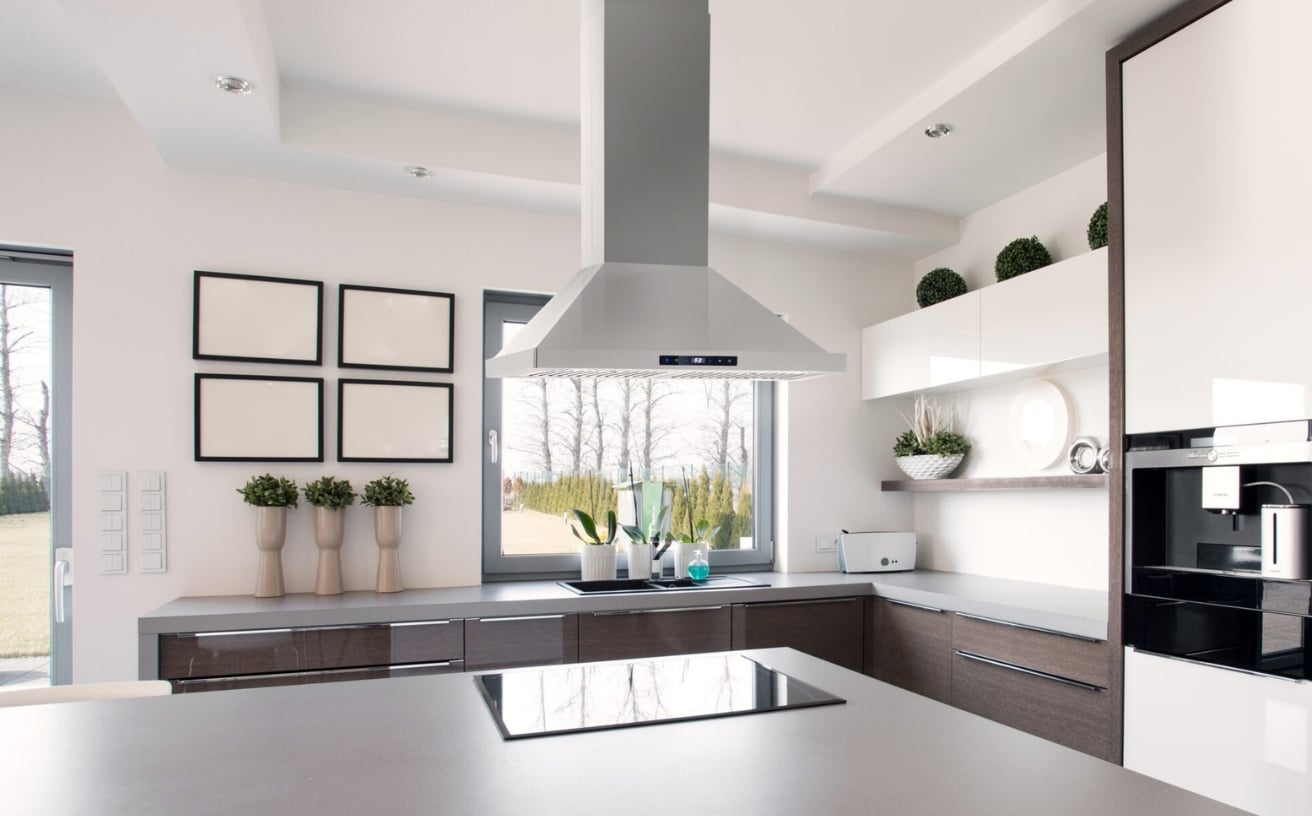
Placing your cooktop in the center of the kitchen changes how ventilation works. Without a back wall to help guide rising smoke, grease, and heat, an island hood has to capture air from all directions while suspended directly from your ceiling joists. This layout rules out standard wall-mount options and requires careful attention to airflow, duct runs, and ceiling support.
To help you find the best island range hood for your layout, we evaluated models across every price tier. We cross-checked manufacturer specifications against installation manuals, dimensional drawings, and long-term owner feedback, focusing on real-world CFM delivery, noise levels, and structural mounting quality.
Our research narrowed the field to ten models built to handle actual daily cooking rather than just looking good in photographs. Whether you need high CFM for a six-burner range, quiet operation for open-concept living, or a design that anchors the room, our guide helps you match the right unit to your ceiling height and cooking habits.
Quick Picks
1. Best All-in-One: ZLINE GL2i Convertible Island Mount Range Hood
2. Best Value: Cosmo COS-668ICS Series Ducted Island Range Hood
3. Best Quiet: Kobe Brillia ISX21 SQB-2 Series Island Range Hood
4.Best Budget Pick: Cosmo COS-63ISS Series Ducted Island Range Hood
5. Best for Heavy Grease: JOEAONZ 700 CFM Convertible Island Range Hood
6. Best for Control: VIKIO HOME RI51 Island Mount Range Hood
7. Best Drum Design: Futuro Futuro Jupiter Island Mount Range Hood
8. Best Recirculating: Klarstein Barett Hanging Island Range Hood
9. Best Insert: Awoco Ceiling Mount Island Range Hood Insert
10. Best Copper: ZLINE 8GL2Hi Designer Series Island Mount Range Hood
Compare the Best Island Range Hoods
Scan the table below for the priority that matters most in your kitchen, whether that’s airflow, noise, or finish, then jump to the full review for the installation details. Every product name links to its full writeup further down the page.
Feature | ZLINE GL2i | Cosmo COS-668ICS | Kobe Brillia ISX21 | Cosmo COS-63ISS | JOEAONZ | VIKIO HOME RI51 | Futuro Futuro Jupiter | Klarstein Barett | Awoco RH-BQ-CR | ZLINE 8GL2Hi |
Best Tag | Best All-in-One | Best Value | Best Quiet | Best Budget Pick | Best for Heavy Grease | Best for Control | Best Drum Design | Best Recirculating | Best Insert | Best Copper |
Max CFM | 700 | 380 | 680 | 380 | 700 | 900 | 940 | About 330 | 700 to 1,000 | 400 |
Noise Level | 51 to 61 dB | 45 dB minimum | 1.0 to 5.0 sones | 45 dB minimum | Under 65 dB | Not published | 3.2 sones | 62 to 72 dB | 38 to 60 dB | 51 to 61 dB |
Fan Speeds | 4 | 3 | 3 | 3 | 3 | 3 | 4 | 3 | 4 | 4 |
Control Type | Push button, LCD | Digital touch | Mechanical push button | Digital touch | Push button | Gesture, touch | Touch, electronic | Button, display | Touch, remote | Push button, LCD |
Venting | Convertible | Convertible | Ducted only | Convertible | Convertible | Ducted only | Convertible | Recirculating only | Ducted only | Convertible |
Filter Type | Baffle, dishwasher-safe | Baffle, dishwasher-safe | Baffle, dishwasher-safe | Baffle, dishwasher-safe | Mesh, dishwasher-safe | Baffle, washable | Mesh, dishwasher-safe | Aluminum, plus carbon | Mesh, dishwasher-safe | Baffle, dishwasher-safe |
Warranty | 3-year parts, lifetime motor | 2-year limited | 2-year parts, 1-year labor | 2-year limited | 1-year limited | 2-year limited | 3-year parts | 2-year limited | 2-year limited | 3-year parts, lifetime motor |
Sizes Available | 30, 36, 42, 48 inch | 30, 36 inch | 30, 36, 42 inch | 30, 36 inch | 30, 36 inch | 30, 36, 42 inch | 14 inch diameter | 14 inch diameter | 30, 36 inch | 30, 36 inch |
Color/Finish Options | Stainless steel | Stainless steel, glass visor | Stainless steel | Stainless steel | Stainless steel, black | Stainless steel | Gold, Copper, White, black, and stainless steel | White, black, stainless | Stainless steel | Hand-hammered copper |
Price Tier | Premium | Mid-Range | Premium | Mid-Range | Budget | Mid-Range | Premium | Budget | Mid-Range | Premium |
Check Price |
About the model numbers. Cosmo gives each width its own suffix in the 668ICS and 63ISS lines, where 750 means 30 inch and 900 means 36 inch. Same hood, different size, nothing more. The Futuro Futuro Jupiter and Klarstein Barett break that pattern. Both are compact drum hoods rated by diameter, chosen for looks rather than full cooktop coverage.
Reviews of 10 Best Range Hoods for Kitchen Island
We evaluated these ten island range hoods on airflow, noise, ceiling and duct requirements, and how clearly each brand discloses what a buyer actually needs to install one. What we found is that island hoods vary more in structural demands than in raw performance, and a hood that looks similar to another in a photo can require a completely different attic setup.
1. Best All-in-One: ZLINE GL2i Convertible Island Mount Range Hood
Specs at a glance
Airflow: 700 CFM (120/240/320/400, 4-speed) | Sizes: 30, 36, 42, and 48 inch | Speeds: 4 | Noise: 51 to 64 dB | Venting: Convertible, 6″ round duct | Filters: Stainless steel baffle, dishwasher-safe | Colors: Stainless steel
What We Like
What We Don’t Like
A kitchen island rarely comes in a standard size, and ZLINE’s GL2i spans four widths built on the same motor and control platform, from a compact 30 inch up to a 48 inch canopy for a wide island cooktop. Sizing up costs nothing in performance, since every width shares the identical 400 CFM, 4-speed motor, which simplifies planning for a contractor working across kitchens with different island dimensions.
The telescoping chimney included in the box covers roughly 8 to 9 foot ceilings out of the box, with a short kit and extension kit sold separately for anything outside that range. That flexibility matters more on an island install than a wall mount, since a mismatched chimney is far more visible when it’s suspended in open space rather than tucked against a wall.
At around 65 pounds for the larger widths, the GL2i is heavy enough that ceiling support planning matters before the hood goes up, not after. The 430-grade stainless steel body resists rust, heat discoloration, and corrosion over years of daily cooking, a detail that matters more on an island hood exposed to view from every angle in the room, though stainless is the only finish offered, so a kitchen calling for black or a colored hood will need to look elsewhere in this lineup.
Dishwasher-safe stainless steel baffle filters handle grease capture, and the unit converts between ducted and ductless operation, though the charcoal filter kit needed for ductless use is sold separately. The push-button control panel with an LCD readout keeps operation simple, and a 3-minute auto timer with delayed shutoff clears residual smoke after cooking wraps up without needing to be switched off manually. We like that ZLINE kept the controls this uncomplicated, since a hood mounted overhead on an island is less convenient to reach and adjust mid-cooking than one on a nearby wall.
At 400 CFM, the GL2i sits well below JOEAONZ’s 700 CFM ceiling, a real gap for anyone running a high-BTU gas range where an island installation already needs more airflow than the same cooktop against a wall. For a standard electric or moderate gas cooktop, 400 CFM is enough, but heavy grill or wok cooking calls for more headroom than this motor provides.
The three-year parts warranty backed by a lifetime motor guarantee gives it staying power most hoods in this price range don’t match. For a household still finalizing which width fits their island, we’d point to the GL2i first as the best island range hood for that kind of flexibility, since sizing up or down costs nothing in performance and leaves fewer compromises than a hood locked to a single width. Read the full ZLINE GL2i review for chimney extension sizing by ceiling height.
2. Best Value: Cosmo COS-668ICS Series Ducted Island Range Hood
Specs at a glance
Airflow: 380 CFM | Sizes: 30 and 36 inch | Speeds: 3 | Noise: As low as 45 dB | Venting: Convertible, optional carbon filter kit | Filters: ARC-FLOW stainless steel baffle, dishwasher-safe | Colors: Stainless steel with tempered glass visor
What We Like
What We Don’t Like
Cosmo built the 668ICS around a curved tempered glass visor paired with a reflective stainless steel body, a design detail that most island hoods in this price range skip in favor of a plain rectangular canopy. Suspended in open space, that visual difference is more noticeable on an island than it would be against a wall, since every angle of the hood stays in view from the surrounding kitchen and living space.
At 380 CFM, the motor handles everyday cooking comfortably, and the noise rating backs up the “quiet” positioning with a real figure rather than marketing language. As low as 45 dB on the lowest setting with rigid ducting, the 668ICS stays unobtrusive enough for an open kitchen where the island sits within earshot of a living room or dining area. The three-speed fan covers a narrower range than four or six-speed hoods, though most home cooks will find the middle setting handles the bulk of everyday tasks, from simmering sauces to clearing steam from a boiling pot.
The digital touch panel includes a built-in timer and clock, a feature multiple owners flagged as doubling as a subtle night light in the kitchen. That timer is built directly into the main control panel rather than requiring a separate accessory, a detail that gets used daily once a household discovers it. ARC-FLOW stainless steel baffle filters are rated for unlimited dishwasher cycles, keeping long-term filter costs at zero, and the unit converts to ductless operation with a separately sold carbon filter kit for kitchens without existing venting.
The 20-gauge stainless body and glass visor are held together with commercial-grade hardware, built to handle the vibration of daily fan operation without loosening over time. That construction quality matters more on an island hood than a wall mount unit, since any rattle or looseness is more noticeable when the hood hangs in open space rather than braced against a wall behind it.
We’d point out that the plainer Cosmo COS-63ISS costs less and shares the same 380 CFM motor and 45 dB noise floor, so the 668ICS’s premium goes almost entirely toward that glass visor and the finish it brings rather than added performance. For a kitchen where the glass front matters as much as the airflow number, that premium makes sense to us. See the full Cosmo COS-668ICS review for a side-by-side against the plain-stainless 63ISS line.
3. Best Quiet: Kobe Brillia ISX21 SQB-2 Series Island Range Hood
Specs at a glance
Airflow: 680 CFM max (280/450/680, 3-speed) | Sizes: 30, 36, and 42 inch | Speeds: 3 | Noise: 1.0 to 5.0 sones | Venting: Ducted only, vertical 6″ round | Filters: Stainless steel baffle, dishwasher-safe | Colors: Commercial grade stainless steel
What We Like
What We Don’t Like
Noise ratings on most range hoods focus on the top speed and leave everything else to guesswork. Kobe’s Brillia ISX21 does the opposite, building an entire mode around the quiet end of the range. QuietMode delivers 280 CFM at 1.0 sone, a figure close to the hum of a quiet refrigerator, before the fan ever needs to climb toward its 680 CFM ceiling.
That top speed brings noise up to 5.0 sones, still restrained next to hoods that hit their maximum output well past that mark. Compared with the Awoco insert’s 2.0 sones on its lowest setting, Kobe’s QuietMode is meaningfully quieter at the bottom of the range, a difference that matters most during long simmering sessions rather than a quick sear. For a kitchen that opens directly into a living or dining space, that gap is the difference between a hood you notice and one you don’t.
The 20-gauge commercial grade stainless steel body and mechanical push-button control favor durability over flash, and the adjustable duct cover fits ceilings from 8 feet up to 10.5 feet with the outer extension, covering most standard residential construction without a custom order. We think the mechanical controls are a genuine strength here rather than a compromise, since fewer electronic components means fewer things that can fail after years of daily use, a preference some buyers will actively choose over a touch panel even when both are available.
Dishwasher-safe baffle filters and an easy-empty catch design cut down on how often the hood needs a deep clean, since grease collects in a dedicated area rather than across the whole housing. That catch design is a small detail that adds up over months of regular cooking, since it removes a step from what would otherwise be a more involved cleaning routine.
Two compromises come with that quiet performance. The ISX21 is ducted only, with no recirculating option for kitchens without existing ductwork, and it’s available exclusively in stainless steel, so a kitchen wanting black or a designer finish will need to look at one of the other picks here. For a kitchen where a running range hood shouldn’t compete with dinner conversation, this is the pick we’d steer buyers toward first, since QuietMode alone justifies the ducted-only limitation for most households. Read the full Kobe Brillia ISX21 review for ceiling height compatibility by duct cover option.
4. Best Budget Pick: Cosmo COS-63ISS Series Ducted Island Range Hood
Specs at a glance
Airflow: 380 CFM | Sizes: 30 and 36 inch | Speeds: 3 | Noise: As low as 45 dB | Venting: Convertible, optional carbon filter kit | Filters: ARC-FLOW stainless steel baffle, dishwasher-safe | Colors: Stainless steel
What We Like
What We Don’t Like
The COS-63ISS strips away the glass visor that defines Cosmo’s 668ICS and keeps the mechanical core intact, the same 380 CFM motor and the same 45 dB noise floor at low speed, in a plain stainless steel body that costs less to produce. For a kitchen island where the hood needs to blend into the room rather than draw attention to itself, that plainer profile is often the better fit anyway, particularly in a traditional or transitional kitchen where the island cabinetry already carries the design weight.
That plainer construction doesn’t mean cheaper components. The 63ISS uses 18-gauge stainless steel, and the ARC-FLOW baffle filters carry the same unlimited-use dishwasher rating found on the pricier 668ICS. We compared the two side by side on performance alone and found little to separate them beyond the finish. The 380 CFM output handles simmering, sautéing, and light frying without straining, though it’s not the choice for heavy wok cooking or a high-BTU gas range that produces heavier, more persistent smoke. A backdraft damper built into the housing also keeps outside air from pushing back through the duct when the fan sits idle.
Digital touch controls with a built-in timer and clock operate identically across both Cosmo island lines, and the three-speed fan covers high, medium, and low settings suited to most home cooking, from a slow simmer to a quick pan sear. Installation supports ducted or ductless operation, with the same CFK1-TM carbon filter kit sold separately for kitchens converting to recirculating mode. The soft-touch panel wipes clean easily after a greasy cooking session, since there are no mechanical buttons or seams to trap residue, and the flat surface reads clearly even with wet or lightly greasy fingers.
Set next to the COS-668ICS900, the gap here is entirely cosmetic, since both hoods share identical airflow, noise, and warranty terms. For a kitchen where a plain stainless finish already suits the design, this is the hood we’d recommend reaching for instead of paying more for a glass visor the layout doesn’t call for. See the full Cosmo COS-63ISS review for installation clearance requirements by width.
5. Best for Heavy Grease: JOEAONZ 700 CFM Convertible Island Range Hood
Specs at a glance
Airflow: 700 CFM | Sizes: 30 and 36 inch | Speeds: 3 | Noise: Under 65 dB | Venting: Convertible, optional carbon filter kit | Filters: 5-layer aluminum mesh, dishwasher-safe | Colors: Stainless steel and black
What We Like
What We Don’t Like
Heavy grease is a volume problem before it’s a filtration problem, and JOEAONZ addresses that directly with a 700 CFM motor built to clear oil-heavy cooking faster than the 380 to 400 CFM hoods common at this price. That output nearly doubles ZLINE’s GL2i, a meaningful gap for anyone frying or wok cooking regularly on an island range where lingering oil smoke is a daily concern rather than an occasional one.
The 5-layer aluminum mesh filters are the mechanism doing the real work here. More layers mean more surface area to trap grease before it reaches the motor housing, and the filters are dishwasher-safe, so the added filtration doesn’t translate into more manual scrubbing after a heavy cooking session. An adjustable chimney accommodates ceilings up to roughly 9.5 feet without a separate extension purchase, and the 430-grade brushed stainless steel body paired with curved tempered glass resists corrosion better than a painted or coated finish over years of regular use.
We found the push-button control refreshingly simple across three speeds, and the unit converts between ducted and ductless installation with a separately sold carbon filter kit. Available in stainless steel or black, it’s one of the few hoods here offering a genuine finish choice rather than stainless as the only option, a real advantage for a kitchen with darker cabinetry or hardware. Four LED lights positioned across the underside provide even illumination over both the front and back burners on a wide island cooktop.
Noise climbs to just under 65 dB at the highest setting, audible but not unusual for a motor moving this much air, though the lower two speeds stay comfortably quieter for everyday cooking. The one-year limited warranty is the shortest term among these picks, a real gap against the two-year coverage found on several other picks here. For a kitchen doing frequent frying or high-oil cooking, this is the hood we’d point buyers toward despite that shorter coverage window, since the filtration and airflow do more heavy lifting than most alternatives at this price.
6. Best for Control: VIKIO HOME RI51 Island Mount Range Hood
Specs at a glance
Airflow: 900 CFM (dual motor) | Sizes: 30, 36, and 42 inch | Speeds: 3 | Noise: Not published | Venting: Ducted, 6″ round | Filters: Stainless steel baffle, washable | Colors: Stainless steel
What We Like
What We Don’t Like
VIKIO’s RI51 leads with control rather than raw specifications, pairing a dual-motor 900 CFM system with a two-piece gesture and touch panel that responds to a hand wave near the surface, useful when hands are covered in oil or flour mid-recipe. Sensors on both faces of the hood mean the gesture control works regardless of which side of the island a cook is standing on, a detail that matters more here than on a wall mount hood approached from one direction only.
That 900 CFM ceiling is the strongest of the ten hoods reviewed, ahead of Kobe’s 680 CFM by a real margin for anyone running a high-output gas range on their island. The dual balancing fan design is built for that heavier load, moving large volumes of smoke and cooking odor without a single motor working past its comfortable range, which should extend the hood’s working life under sustained heavy use across years of daily cooking.
A 1 to 15-minute adjustable timer on the gesture panel lets a cook set exactly how long the fan runs after cooking ends, rather than accepting a fixed delay built into the control board that may run longer or shorter than a specific meal actually needs. Stainless steel baffle filters are washable and rated for repeated use, and VIKIO backs the motor, switch control, and LED lighting with a two-year replacement guarantee that covers the components most likely to fail first. The 19-gauge stainless body is thick enough to resist the flex and vibration that a lighter-gauge hood can develop over years of daily fan cycling.
We want to flag a real gap here. VIKIO does not publish a sone or decibel rating for the RI51 anywhere we could verify, which makes it the one hood here where noise output is genuinely unknown going in. Given the size of the dual motor, a buyer sensitive to noise should treat that as an open question rather than assume quiet operation. For a kitchen where hands-free control and high CFM matter more than a documented noise figure, the RI51 stands out as one of the best island mount range hood options built around that exact combination.
7. Best Drum Design: Futuro Futuro Jupiter Island Mount Range Hood
Specs at a glance
Airflow: 940 CFM max (150 to 940 CFM range) | Sizes: 14 inch diameter | Speeds: 4 | Noise: 3.2 sones | Venting: Convertible, optional carbon filter | Filters: Mesh, dishwasher-safe | Colors: Gold, Copper, White, black, and stainless steel
What We Like
What We Don’t Like
Most island hoods scale their canopy to match a cooktop’s width. Futuro Futuro’s Jupiter does the opposite, packing a 940 CFM blower into a 14 inch cylindrical drum designed as a standalone design statement rather than a full-coverage canopy, a distinction that shapes almost every other decision about how and where to install it.
Where ZLINE’s GL2i spans up to 48 inches to match a wide cooktop, the Jupiter’s 14 inch diameter means it works best centered over a single burner zone or as one element in a larger ventilation plan, not as the sole hood over a full range. We’d flag that distinction as the one thing to confirm with a kitchen designer before ordering rather than after installation, since it matters more here than for any other pick among these ten hoods.
The body is built from AISI 304 stainless steel with an electrolysis-infused finish, a process that fuses the color into the metal rather than sitting on top of it as a coating, which should hold up to scratching better than a painted surface over years of wiping down and handling during cleaning. The sound-absorbing chamber built around the blower keeps noise to 3.2 sones despite the compact housing, and the touch-sensitive electronic panel includes a 15-minute delayed shutoff to fully clear odors after cooking. Dishwasher-safe mesh filters handle grease capture, and the hood converts to ductless operation with an additional carbon filter for kitchens without existing venting.
Available in 5 different colors, with several other finishes sold under the same Jupiter platform, this hood functions as much as a design object as a ventilation appliance. Genuine Italian craftsmanship extends to the assembly process itself, with each unit hand-finished rather than mass-produced on an automated line. Our take is that buyers drawn to the Jupiter already know they want a sculptural accent piece rather than a conventional canopy, and that craftsmanship is largely what justifies the premium price for that specific use case. See the full Futuro Futuro Jupiter review for placement guidance relative to burner position.
8. Best Recirculating: Klarstein Barett Hanging Island Range Hood
Specs at a glance
Airflow: About 330 CFM (560 m³/h) | Sizes: 14 inch diameter (35 cm) | Speeds: 3 | Noise: 62 to 72 dB | Venting: Recirculating only | Filters: Aluminum grease filter, plus carbon filter | Colors: Stainless steel, white, and black
What We Like
What We Don’t Like
Not every island has an accessible ceiling duct path leading to the exterior, and that single limitation is what the Klarstein Barett is built around. It never connects to ductwork at all, relying entirely on an aluminum grease filter paired with an included activated carbon filter to recirculate cleaned air back into the room, a design choice that trades some filtration thoroughness for installation freedom.
That recirculating-only design caps output at roughly 330 CFM, well below the Cosmo COS-63ISS’s 380 CFM despite both hoods serving a similar light-duty cooking role. Ductless filtration is inherently less thorough than venting outside, so that lower ceiling reflects a real compromise in what the hood can actually remove from the air, not just a number on a marketing page, and buyers should factor that into expectations for heavier cooking such as searing or high-smoke stir-frying.
Suspended on steel cables at an adjustable height up to 140 centimeters, the Barett’s chandelier-style profile reads as a lighting fixture as much as a range hood, a genuine design departure from the canopy shape every other pick here shares. Installation is comparatively simple since there’s no duct run to plan, just a ceiling mount point and four cable clamps that need to sit level with one another, a job most homeowners could complete in an afternoon without hiring a contractor. Button controls with a digital display step through three power levels, and the included LED lighting doubles as task lighting over the cooktop below, useful in a kitchen without strong overhead lighting elsewhere.
We’d flag the noise rating as the place this hood needs the closest look. At 62 to 72 dB, it runs louder than every ducted option covered here, a real cost of pushing air through a filter stack instead of straight outside. For a rental kitchen or an island where running new ductwork simply isn’t possible, we’d still call that noise compromise the only realistic path to any ventilation at all. Read the full Klarstein Barett review for carbon filter replacement scheduling.
9. Best Insert: Awoco Ceiling Mount Island Range Hood Insert
Specs at a glance
Airflow: 700 to 1,000 CFM (duct size dependent) | Sizes: 30 and 36 inch | Speeds: 4 | Noise: 38 to 60 dB | Venting: Ducted, 6″ or 8″ round | Filters: 4-layer mesh, dishwasher-safe | Colors: Stainless steel
What We Like
What We Don’t Like
A range hood doesn’t have to hang visibly below the ceiling to work, and Awoco’s insert makes that case directly by mounting flush so the canopy disappears into the ceiling line rather than adding a suspended element to the room. It stands out as the best ceiling mount range hood among these ten picks for that exact reason, a genuine fit for a minimalist kitchen that wants ventilation without a design statement attached to it, since the finished ceiling reads as uninterrupted from most angles in the room.
Choosing between the 6 inch and 8 inch duct configuration changes the CFM ceiling meaningfully, from 700 CFM on the smaller duct up to 1,000 CFM on the larger one, giving a buyer real control over output based on whatever duct path already exists in the ceiling. Five interchangeable vent directions, one top and four sides, add flexibility that fixed-vent hoods elsewhere in this lineup don’t offer, since the blower can route toward whichever wall the attic duct run already reaches without added ductwork. The 140-watt motor draws modest power for the CFM it delivers, and the touch sensor panel sits flush with the ceiling surface alongside the canopy itself.
We like that Awoco publishes noise figures at both ends of the range rather than just a single headline number. The spread runs from 38 dB (2.0 sones) at the lowest speed up to 60 dB (9.0 sones) at the highest, wider than Kobe’s ISX21 posts across its own three speeds. That top-end figure is louder than Kobe’s maximum, though Awoco’s low-speed number undercuts it, so the two hoods trade the advantage depending on which speed a cook actually runs most often.
The 4-layer dishwasher-safe mesh filters and included remote control round out a genuinely functional package, though the insert comes in stainless steel only and requires existing ductwork, ruling out any ductless conversion. For a kitchen where the ceiling itself needs to stay visually clean, this is the flush design we’d reach for over any canopy-style hood in this lineup. Check out the full Awoco RH-BQ-CR review for vent direction configuration options.
10. Best Copper: ZLINE 8GL2Hi Designer Series Island Mount Range Hood
Specs at a glance
Airflow: 400 CFM (120/240/320/400, 4-speed) | Sizes: 30 and 36 inch | Speeds: 4 | Noise: 51 to 61 dB | Venting: Convertible, 6″ round duct | Filters: Stainless steel baffle, dishwasher-safe | Colors: Hand-hammered copper
What We Like
What We Don’t Like
For a kitchen built around warm metal tones, stainless steel can read as cold no matter how well it performs, and ZLINE’s 8GL2Hi solves that by swapping the exterior for a hand-rubbed, 7-layer copper finish over the same 304-grade stainless body used on its standard hoods. We think that finish choice matters more on an island installation than anywhere else in a kitchen, since the hood stays in view from every seat at the counter. That finish is also outdoor-approved, resisting the tarnishing that a lesser copper coating would show within a few years of kitchen humidity and heat.
Underneath that finish sits the identical 400 CFM, 4-speed motor and 51 to 61 dB noise range found on the standard GL2i, since this is the same core platform dressed in a different material rather than a separate engineering effort, right down to the push-button control layout and LCD timer readout. A buyer choosing between the two is deciding on finish alone, not performance, a distinction worth confirming before paying the copper premium.
That shared platform also carries over the three-year parts warranty backed by a lifetime motor guarantee, a genuinely strong term for a designer finish that typically commands a real premium over plain stainless hoods generally. Dishwasher-safe stainless steel baffle filters keep maintenance identical to the standard GL2i as well, so day-to-day upkeep doesn’t change with the upgraded finish, though the copper exterior itself should be cleaned with a non-abrasive cloth rather than a standard degreaser to preserve the hand-rubbed patina.
Two things separate this from its stainless sibling. First, copper is the only finish offered, so a kitchen wanting to match this hood to other copper fixtures has no width beyond 30 and 36 inches to work with. Second, the unit ships in multiple boxes and needs minimal assembly on arrival, more setup than a single-box hood requires. We’d call this the pick for a kitchen where the hood is meant to double as the room’s focal point, since that copper finish does work no stainless steel model here can match. Read the full ZLINE 8GL2Hi review for copper finish care and maintenance guidance.
Explore More Range Hood Guides
Want to see how under cabinet installations compare for smaller kitchens? Browse our best under cabinet range hood picks.
Factors to Consider When Buying an Island Range Hood
An island installation asks more of both the hood and the kitchen structure than a wall mount or under cabinet unit does. Here’s what actually separates a good fit from a bad one.
Determine How Much CFM Your Island Needs
Island cooktops lose the wall and backsplash that help funnel smoke into a wall mount hood, so the same cooktop needs meaningfully more airflow once it moves to an island. That gap isn’t a minor technical detail. It’s the single specification decision buyers get wrong most often on this installation type.
Plan for roughly 25 to 30 percent more CFM than the same cooktop would need against a wall. A 30 inch electric cooktop that’s comfortable at 300 CFM on a wall mount needs closer to 400 CFM in an island position, and a 36 inch gas range served well by 600 CFM on a wall needs 750 to 900 CFM once it moves to the center of the room.
If your cooktop runs hot or wide, look toward the VIKIO RI51 or JOEAONZ picks in this lineup rather than the 380 to 400 CFM options built for lighter cooking.
Size the Hood Wider Than Your Cooktop
A wall mount hood can match cooktop width and still perform well, since the wall behind it blocks lateral escape. An island hood has no such backing, so matching width exactly leaves the front and side burners partially outside the capture zone.
The stronger sizing rule is at least 6 inches wider than the cooktop, with 3 inches of overhang on each side. A 30 inch cooktop calls for a 36 inch hood, and a 36 inch cooktop calls for a 42 inch model. ZLINE’s GL2i and Kobe’s Brillia line both scale up to 42 or 48 inches to accommodate that rule.
The Futuro Futuro Jupiter and Klarstein Barett sit outside this logic entirely, since both are compact accent hoods rather than full-coverage canopies, and should be evaluated on their own use case rather than matched to cooktop width.
Plan for Ceiling Support and Duct Runs
A wall mount hood anchors to studs behind it. An island hood hangs from the ceiling alone, and the structure above needs to support the full weight of the unit, which runs from around 30 pounds for a compact drum hood up to 65 pounds or more for a full-width stainless canopy. Island range hood height above cooktop typically runs 30 to 36 inches, a few inches higher than the wall mount standard, to account for the open sightlines on all four sides.
Many homes need dedicated blocking installed between ceiling joists before an island hood goes up, a framing-level task rather than a simple fastener job. Ductwork then has to run horizontally through the ceiling plenum to an exterior exit, and every bend in that path reduces the CFM that actually reaches the hood.
Confirm your attic access and duct path before ordering, since correcting a duct route after installation is far more disruptive than planning it upfront. Our buying guide to choosing a range hood covers duct planning in more depth for any installation type.
Choose Between Ducted and Recirculating
Ducted island hoods vent outside through the ceiling and remove smoke, grease, and moisture completely. Recirculating hoods filter air through carbon and return it to the room, a real compromise in thoroughness but the only option where running new ductwork isn’t practical.
Most hoods in this lineup are convertible, giving a buyer flexibility either way, though Kobe’s ISX21, VIKIO’s RI51, and Awoco’s insert are ducted only, and Klarstein’s Barett is built exclusively for recirculating use.
If your island can’t support a duct run to the exterior, narrow your search to Klarstein or one of the convertible models here, and budget for the separate carbon filter kit most convertible hoods require for ductless operation..
Compare Noise Ratings at Working Speed
Noise ratings appear in either decibels or sones across these ten picks, and the two scales don’t convert directly, which makes side-by-side shopping harder than it should be. As a rough anchor, 40 dB sits close to a quiet library, 60 dB close to normal conversation, and 70 dB and above starts to compete with talking in the room.
Among the models compared here, that range runs from Kobe’s 1.0 sone QuietMode up to Klarstein’s 72 dB maximum, a real gap for anyone cooking near an open living space.
Check the rating at the speed you’ll actually run most, not just the lowest or highest number a listing leads with, since several hoods here post a wide spread between their quietest and loudest settings.
Price Tier at a Glance
Tier | What It Typically Delivers |
Budget | 330 to 700 CFM, 3-speed control, 1 to 2-year warranty, stainless steel finish |
Mid-Range | 380 to 700 CFM, 3 to 4-speed control, 2-year warranty, glass or flush-mount design options |
Premium | 400 to 940 CFM, 3 to 4-speed control, 3-year to lifetime motor warranty, designer or specialty finishes |
Match the Finish to an Open Sightline
An island hood is visible from every angle in the room, unlike a wall mount hood that only shows its front face. That visibility is why choosing the best island kitchen hood often means weighing finish as heavily as CFM, since a hood suspended over an island functions as a design element whether or not that was the intent.
Stainless steel remains the safest choice because it reads neutrally from any angle, but it’s not the only option here. Cosmo pairs stainless with a tempered glass visor, Futuro Futuro offers a compact drum in white, black, or stainless, Klarstein leans into a chandelier silhouette, and ZLINE’s 8GL2Hi swaps steel for hand-hammered copper entirely.
Match the finish to the sightlines from your living or dining area, not just the cooktop below it, since an island hood reads as part of the room’s overall design far more than a hood tucked against a wall.
FAQ
How much CFM do I need for an island range hood?
Plan for about 25 to 30 percent more CFM than the same cooktop would need on a wall mount hood, since an island cooktop loses the wall backing that helps funnel smoke. A 30 inch electric cooktop typically needs around 400 CFM on an island, and a 36 inch gas range often needs 750 to 900 CFM.
How wide should an island range hood be compared to the cooktop?
At minimum, match the cooktop width, but the stronger specification is 6 inches wider than the cooktop, with 3 inches of overhang on each side. That extra width improves capture at the front and side burners, where an island hood has no wall to block lateral escape.
Can an island range hood be ductless?
Some can. Convertible models recirculate air through a carbon filter instead of venting outside, though a few hoods in our comparison, including Kobe’s Brillia ISX21 and Awoco’s ceiling insert, are ducted only. Klarstein’s Barett is built exclusively for recirculating use with no ducted option at all.
How difficult is it to install an island range hood?
More demanding than a wall mount installation in most kitchens. The ceiling structure has to support the hood’s full weight, often requiring dedicated blocking between joists, and ductwork has to run horizontally through the ceiling to an exterior exit. Our guide to choosing a range hood covers installation planning in more detail.
Are island range hoods louder than wall mount hoods?
Not inherently, though they often run louder in practice. Island hoods need higher CFM to match a wall mount hood’s capture efficiency, and higher airflow generally means more fan noise at a given speed. Checking the sone or decibel rating at your expected working speed matters more than the installation type itself.
What size island range hood do I need for a 36-inch cooktop?
A 42 inch hood is the stronger specification, following the 6-inch-wider sizing rule that applies to island installations. A 36 inch hood matched exactly to a 36 inch cooktop will still work, but it leaves less margin for capturing smoke from the front and side burners.
Do island range hoods need extra ceiling support?
Often, yes. Full-width canopy hoods can weigh 50 pounds or more, and many ceilings need dedicated blocking installed between joists before the hood goes up. Confirm your ceiling structure and attic access before ordering, since retrofitting support after installation is far more disruptive than planning for it upfront.
Final Verdict
The best island range hood depends on your cooktop’s width and output more than any other installation type covered on this site, since an island loses the wall backing that makes sizing more forgiving elsewhere. For most kitchens, the ZLINE GL2i is our top recommendation, spanning four widths on a single reliable motor platform backed by a lifetime motor warranty.
Budget-focused shoppers should look to the Cosmo COS-63ISS or the Klarstein Barett, depending on whether existing ductwork is available. For a gas range that runs hot, the VIKIO RI51 and JOEAONZ picks provide the CFM headroom lighter-duty hoods can’t match, while Kobe’s Brillia ISX21 remains the standout choice for anyone prioritizing quiet operation above all else.
Design-forward kitchens have real options beyond stainless steel here. The ZLINE 8GL2Hi brings a hand-hammered copper finish to a proven motor platform, the Cosmo COS-668ICS pairs a tempered glass visor with reliable performance, and the Futuro Futuro Jupiter works as a sculptural accent for a kitchen that wants a hood to double as a design statement. For a ceiling that needs to stay visually clean, Awoco’s flush insert remains the standout pick for that specific priority.
Whichever model fits your kitchen, confirm your ceiling structure and duct path before you order. Getting those details right the first time saves a costly correction after the hood is already hanging.
Explore More
- Best wall mount range hoods
- Best under cabinet range hoods
- Best ducted range hoods