
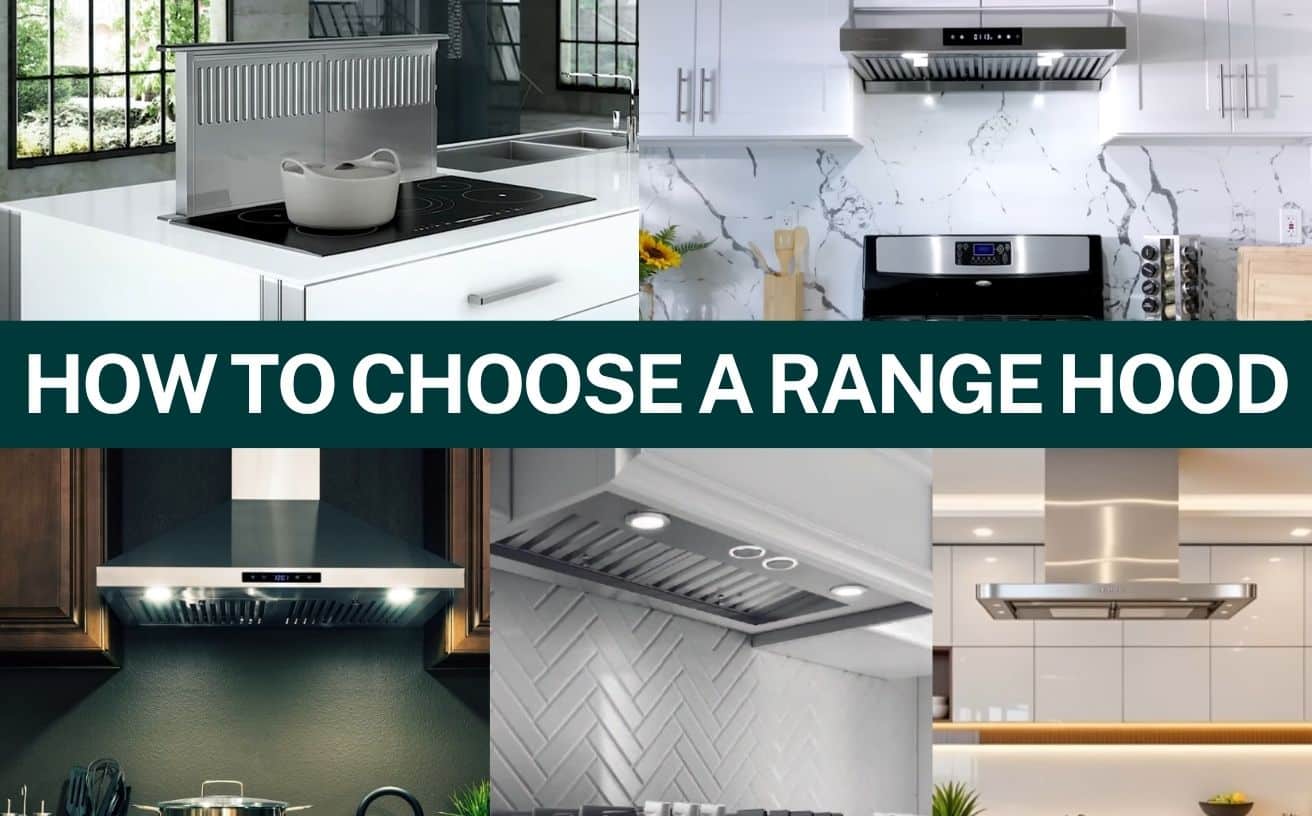
Choosing a range hood involves more variables than most appliance decisions. Your kitchen layout, venting access, cooktop type, cooking habits, noise tolerance, and your budget all factor in, and getting any one of them wrong creates problems that are expensive to fix after installation.
This guide covers every factor in the order it matters, so your decision is grounded in what your kitchen actually needs rather than what a product page suggests.
In our assessment, the most common buying mistakes are choosing based on appearance first, selecting a CFM rating that does not match your cooktop output, and assuming all hoods install the same way regardless of kitchen configuration. This guide is written for homeowners planning a kitchen build or remodel, buyers replacing an outdated hood, and anyone who wants to understand the decision before comparing specific models.
Quick Guide
For a quick recommendation, start with the option that best matches your kitchen layout and cooking needs:
- Standard kitchens with upper cabinetry: Under-cabinet ducted range hood
- Kitchens without overhead cabinetry: Wall-mount chimney hood
- Island cooktops: Island range hood, ceiling-mounted and ducted
- Apartments or kitchens without duct access: Ductless convertible hood with charcoal filter
- Gas ranges and heavy cooking: Ducted wall-mount or insert hood, 600 CFM minimum
- Open-plan kitchens: Island or wall-mount hood, 2.0 sones or below at medium speed
- Tight budgets: Under-cabinet ducted hood in the mid-range ($300 to $700)
- Custom kitchen builds: Insert hood installed inside a dedicated cabinetry surround
1. Start With Your Kitchen Layout
We recommend starting here before you look at a single product listing. Your kitchen layout determines which hood types are physically possible before price, CFM, or design enter the conversation. The position of your cooktop and the presence or absence of overhead cabinetry will narrow the field considerably.
Standard Kitchens With Upper Cabinetry

If your kitchen has a cabinet sitting directly above the cooktop, consider an under-cabinet range hood the default starting point. It mounts to the underside of that cabinet, keeps a compact profile, and installs without structural modifications in most homes.
It is the most widely available configuration across all price ranges and suits the majority of standard residential kitchen layouts. If under-cabinet is your layout match, the under-cabinet range hood buying guide walks through what to consider before you buy.
Kitchens Without Overhead Cabinetry

If your upper cabinetry has been removed or was never installed above the range, a wall-mount chimney hood is suitable for you. It anchors directly to your wall, extends upward through a decorative chimney section that conceals the ductwork, and requires no overhead cabinet for structural support.
In our experience, wall-mount hoods also offer meaningfully higher CFM capacity than most comparable under-cabinet models at a similar price point. Before you compare models, see the wall-mount range hood buying guide that features what to evaluate at this configuration.
Cooktops on a Kitchen Island

If your cooktop sits on a kitchen island away from any wall, an island range hood is the only purpose-built option. It mounts from the ceiling and captures airflow on all four sides of your cooking surface. Before you select any model, must confirm two things: that your ceiling structure can support the hood’s weight and that a duct path through the ceiling to the exterior is accessible.
Discovering either issue after purchase adds significant cost and delay. For what to confirm before you select a model for island cooktop, see our island range hood buying guide.
Kitchens With a Custom Cabinetry or Decorative Hood Enclosure

If your renovation includes a dedicated built enclosure above the cooktop, a built-in hood insert is the appropriate choice. It is a self-contained ventilation unit designed to sit inside a custom structure. The enclosure becomes the visible exterior, the insert handles the mechanics behind it.
Before the cabinetry is built or ordered, confirm the insert’s minimum cavity dimensions against the manufacturer spec sheet. Getting that sequence wrong is the most common and most avoidable mistake in custom hood builds. Before construction begins, our range hood insert buying guide explores what to confirm at the planning stage.
Kitchens Where Overhead Installation Is Not Possible
If your kitchen has vaulted ceilings, an unusual configuration, or an open layout where neither a wall-mount nor an island hood is structurally feasible, a downdraft system is a practical alternative. It pulls air downward through ductwork routed beneath the floor rather than above your cooking surface.

Downdraft systems work, but they work against the natural direction of rising smoke and steam, which makes them noticeably less effective for high-heat cooking than any overhead hood configuration. If your build includes a dedicated cabinetry surround, an insert hood is another path worth considering.
2. Range Hood Types at a Glance
Not all range hoods suit every kitchen. Here is how the main types compare before we get into the detail.
Hood Type | Best Kitchen Fit | Typical CFM Range | Ducted / Ductless | Relative Cost | Installation Complexity |
Under-Cabinet | Standard kitchens with upper cabinetry | 200–600 CFM | Both | Low–Mid | Low |
Wall-Mount (Chimney) | Kitchens without overhead cabinetry | 300–900 CFM | Both | Mid–Premium | Moderate |
Island | Island cooktops, open-plan kitchens | 400–1,200 CFM | Ducted only | Premium | High |
Insert (Built-In) | Custom cabinetry builds | 300–1,200 CFM | Both | Premium | High |
Downdraft | No overhead install possible | 300–600 CFM | Ducted preferred | Mid–Premium | High |
Convertible | Uncertain venting, rentals | 200–500 CFM | Both | Low–Mid | Low–Moderate |
CFM ratings above reflect the range across models in each category. Your specific CFM requirement depends on your cooktop type and output, which we cover in the CFM section below.
3. Understand Your Ventilation Options
Ducted or ductless is not a stylistic choice. It determines how well your hood performs long-term, what ongoing maintenance costs look like, and what the hood is physically capable of removing from your kitchen air. Most buying guides treat it as a footnote. It should be the first thing you decide.
Ducted (Vented) Range Hoods
A ducted range hood pulls air through a grease filter and exhausts it entirely outside your home through a duct system. Because contaminated air leaves your kitchen rather than being filtered and recirculated, ducted systems consistently outperform ductless configurations for smoke removal, moisture control, and odor elimination. If your home can accommodate exterior venting, this is the configuration we recommend.
Before you commit to a ducted model, confirm a duct path exists from your hood location to the exterior. That path can run through a wall, ceiling, or roof depending on where your kitchen sits in the home. In our view, confirming this route before selecting a model is the single step that prevents the most common and costly installation problems people face.
If you have confirmed your duct path and are ready to compare models, see our best ducted range hoods guide.
Ductless (Recirculating) Range Hoods
A ductless hood passes air through a grease filter and a charcoal filter, then returns the cleaned air to your kitchen. No ductwork or exterior penetration is required, which makes them straightforward to install in apartments, rental properties, and kitchens where exterior venting is genuinely not an option. We recognize that for many buyers, ductless is the only practical choice.
The performance limitations are real, however. Charcoal filters absorb odors but do not remove heat or moisture from your kitchen. Your filters will need replacement every three to six months at an average cost of $15 to $40 per filter set depending on brand and model. If you cook on a gas range or use high-heat methods regularly, we do not recommend ductless as your primary ventilation solution.
If ductless is your only practical option, our best ductless range hoods guide covers the strongest performers in that configuration.
Convertible Range Hoods
Convertible hoods are built to operate in either configuration. They ship with ducted compatibility and include a recirculating kit for installations without exterior venting access. If you are uncertain about your venting options, or if you rent and may relocate the hood in the future, we consider a convertible hood a practical and flexible middle ground.
Related Guide: Ducted vs Ductless Range Hood Compared
4. Size Your Hood to Your Cooktop
In our assessment, hood width is where the most consistent performance problems start. Hoods that are too narrow for the cooktop they serve are the single most common sizing mistake we see across kitchen configurations.
Width: Matching or Exceeding the Cooktop
Our recommendation is to match your hood width to your cooktop at minimum, and to size up where your cabinet space allows. If you cook on a gas range, we suggest a hood that extends three to six inches beyond your cooktop edge on each side to capture the wider plume that high-BTU burners produce.
Standard hood widths run at 30, 36, 42, and 48 inches. A 30-inch hood above a 30-inch electric range is adequate for most households. A 36-inch hood above a 30-inch gas range is the better choice. If your kitchen has a professional-style range with a wider burner configuration, a 42 or 48-inch hood is appropriate.
Mounting Height Above Your Cooktop
Mounting height affects both how well your hood captures rising air and your safety at the cooktop. Here are the clearance figures we recommend working from:
- Gas cooktops: 24 to 36 inches between the cooktop surface and the bottom of your hood
- Electric and induction cooktops: 20 to 30 inches
Always verify your specific model’s clearance specifications, as manufacturer figures take precedence over general guidelines. Mounting too high reduces capture efficiency. Mounting too low creates a fire risk and restricts the airflow your hood needs to perform.
5. Calculate the CFM Your Kitchen Actually Needs
CFM, cubic feet per minute, measures how much air your hood moves. It is the single most important performance specification to get right. In our view, this is where the most buying mistakes happen: buyers either underestimate what their cooktop requires or choose a very high CFM without considering what that means for their home’s air pressure balance.
CFM ratings for residential range hoods are verified through the Home Ventilating Institute (HVI) certification program, which independently tests and publishes airflow performance data for certified products. When you are comparing models, we recommend checking whether a hood carries HVI certification, which confirms the rated CFM figure reflects real-world performance rather than manufacturer self-reporting.
CFM for Gas Cooktops
The industry standard is 100 CFM per 10,000 BTU of your combined burner output. Here is how that translates to real kitchen scenarios:
- Standard four-burner gas range (40,000 total BTU): minimum 400 CFM
- Semi-professional range (60,000 total BTU): minimum 600 CFM
- Commercial-style residential range (80,000+ total BTU): 800 to 1,200 CFM
We recommend adding a 20 percent buffer above your calculated minimum to account for duct run length and turns, which reduce the CFM your hood actually delivers at the cooking surface.
CFM for Electric and Induction Cooktops
If your kitchen runs on electric or induction, your CFM requirements are lower. Our starting point is 100 CFM per linear foot of your cooktop width:
- 24-inch cooktop: 200 CFM minimum
- 30-inch cooktop: 300 CFM minimum
- 36-inch cooktop: 400 CFM minimum
These figures are adequate for regular household cooking at standard use. If you cook heavily on your induction or electric cooktop, sizing up is worth considering.
When Your CFM Rating Requires Makeup Air
One step that buyers consistently overlook at this stage is makeup air, and skipping it on a high-CFM installation is not a minor oversight. It is a safety issue. If your hood is rated above 400 CFM, it can depressurize a tightly built home by exhausting more air than the home naturally replaces. The result is negative pressure, which causes backdrafting through your fireplace, gas water heater, and furnace flues. This is a safety issue, not just a comfort problem.
If your home was built after 2000 with high air sealing, we recommend consulting an HVAC professional about makeup air requirements before you purchase any hood rated above 400 CFM. Makeup air systems typically cost $500 to $2,000 installed, and planning for one upfront is far less expensive than retrofitting after your high-CFM hood is already in place.
6. Consider Noise Levels Before You Buy
In our view, noise is the most overlooked specification in this category and the most commonly cited disappointment after installation. We recommend reviewing sone ratings before you purchase rather than discovering your hood’s noise level after it is mounted.
What Sone Ratings Mean for Your Kitchen
Sones measure perceived loudness in a way that maps more closely to real-world experience than decibel figures. Here is our reference scale to help you evaluate what you are looking at:
- Under 1.0 sone: Near-silent, comparable to a quiet refrigerator hum
- 1.0 to 2.0 sones: Quiet enough that background noise does not affect conversation
- 2.0 to 4.0 sones: Noticeable but acceptable in most enclosed kitchens
- Above 4.0 sones: Loud enough that you will need to raise your voice nearby
Most hoods run meaningfully quieter at medium speed than at maximum. We recommend checking sone ratings at the medium setting, since that is the speed your hood will run at for most everyday cooking. A hood rated at 5.0 sones at maximum may perform at 1.5 sones at medium, which is perfectly acceptable for daily use.
Noise and Your Kitchen Layout
If your kitchen is open-plan and connects directly to your living or dining area, we recommend prioritizing hoods rated at 2.0 sones or below at medium operating speed. Noise travels further in open layouts, and an island hood positioned centrally in your space will be heard throughout the room. In an enclosed kitchen, your tolerance for higher sone ratings can reasonably be greater.
Motor Placement and Noise Reduction
Where your blower motor sits affects how much noise reaches your kitchen. Internal blowers are built into the hood body and are the most common and least expensive configuration. External blowers mount on the exterior wall or roof, moving the noise source entirely outside your home, which makes a meaningful difference on high-CFM installations. Inline blowers sit within your duct run and offer a middle ground: meaningfully quieter than internal blowers without the full complexity of an external installation. For high-CFM setups in open-plan spaces, we consider an external or inline blower worth the additional cost.
7. Choose the Right Filter Type
We recommend confirming the filter type before you purchase, not after. It determines how often you will need to maintain your hood, how well it handles your cooking’s grease load, and whether part replacement becomes a recurring expense you need to budget for.
For a full breakdown of how each filter type works and what your maintenance commitment looks like, see our complete guide to range hood filter types.
8. Match Your Hood to Your Cooking Style
Your cooking habits determine your specifications more directly than any other factor. What follows translates that connection into concrete CFM, filter, and ventilation requirements based on how you actually cook.
- If you cook lightly (electric or induction, occasional use): We recommend 200 to 400 CFM, a mesh or baffle filter, and a ductless configuration is acceptable where venting is not available. An entry-level to mid-range hood handles your use case well.
- If you cook moderately (everyday gas or electric, standard household): Our recommendation is 400 to 600 CFM with a ducted system and a baffle filter. Most mid-range hoods in the $300 to $700 range are well-suited to your needs here.
- If you cook heavily (high-BTU gas ranges, wok cooking, frequent high-heat methods): We recommend 600 to 1,200 CFM with a ducted system. This is not a preference but a requirement for your ventilation to keep up. A professional-style hood is appropriate, and at this CFM level, makeup air provisions should be evaluated before you install.
9. Set Your Budget Realistically
In our assessment, price and performance are more reliably correlated in this category than in many appliance segments. Here is what each budget tier actually delivers so you know what your money is buying:
- Entry-level ($100 to $300): Under-cabinet hoods with mesh filters, push-button controls, and basic lighting. If your cooking is light, your kitchen is a rental, or this is a secondary space, this tier is adequate. Motor lifespan and noise control are where your money is most noticeably saved.
- Mid-range ($300 to $700): Under-cabinet or wall-mount hoods with baffle filters, variable fan speeds, and LED lighting. This is the tier we recommend for most households with a standard gas or electric range. You get reliable daily performance and reasonable build quality at a price that makes sense for most kitchen budgets.
- Premium ($700 to $2,000 and above): Wall-mount, island, or insert hoods with high CFM output, low sone ratings, and quality finish options. If you cook seriously, run a high-BTU gas range, or your hood is a significant design element in your kitchen, this is the tier worth spending into.
Warranty length is a useful proxy for manufacturer confidence in build quality. Entry-level hoods typically carry a one-year warranty. Mid-range and premium hoods from established brands typically offer three to five years on the motor and one to three years on parts. If a hood in the mid-range price tier carries only a one-year warranty, treat that as a signal about build quality before assuming the price makes it representative of the tier.
Where budget hoods cut corners most visibly is motor lifespan, noise control at higher fan speeds, and finish durability over time. If your kitchen runs a gas range or your cooking is regular and heavy, we recommend at minimum a mid-range hood. The performance and longevity difference justifies the cost difference.
10. Finish and Design Considerations
Finish is the one specification where personal preference is the deciding factor rather than performance. The options available to you depend on your budget tier: stainless steel is the standard across all tiers and available on virtually every model, black stainless and specialty finishes appear at the mid-range and above, and custom color or panel-ready configurations are found primarily in the premium insert category.
One check worth making before you commit to a purchase: confirm the hood body, chimney section, and filter face all share the same finish variant. On some models these components ship in slightly different finishes. Catching this in the product specification sheet before ordering takes less than a minute and avoids a return.
11. Account for Your Installation Requirements Before You Buy
Confirm your installation requirements before you select a model, not after. Discovering an unexpected duct run or a ceiling that cannot support an island hood after purchase adds cost and disruption that upfront planning avoids entirely.
Your Duct Access and Exterior Venting Path
For ducted hoods, we recommend mapping your duct route to the exterior before committing to any model. Common paths run through an exterior wall directly behind your cooktop, up through your cabinetry and out a soffit, or through your ceiling and roof. Longer duct runs with multiple direction changes reduce the CFM your hood delivers. Each 90-degree elbow in your duct path reduces effective airflow by approximately 10 percent, which adds up quickly if your route involves several turns.
Duct Size and Your Hood’s CFM Requirement
Connecting your high-CFM hood to an undersized duct restricts your airflow, reduces performance, and increases operating noise. Our recommendation is to verify the duct diameter your model requires before you plan your duct route. Most hoods in the 400 CFM range require a 6-inch duct. If your hood is rated at 600 CFM or above, expect a 7- or 8-inch duct requirement.
Electrical Requirements
Most residential range hoods operate on a standard 120V household circuit. If your hood is a high-CFM professional-style model with an external blower rated above 900 CFM, it may require a dedicated 20-amp circuit. Confirm your specific model’s electrical requirement in the product specifications before your installation planning begins.
DIY vs Professional Installation
If you are replacing an under-cabinet hood in an existing cabinet opening with an existing duct path, that is a manageable DIY project provided you are comfortable with basic electrical and carpentry work. If your installation involves a new wall-mount hood, an island hood requiring ceiling mounting, or any new ductwork, professional installation is the better choice. Budget $150 to $500 for a standard professional replacement, and more if your project involves new duct runs or structural reinforcement. To learn more about this, Read our DIY vs Professional Range Hood Installation Guide.
Final Thoughts
Our consistent recommendation across every kitchen type and budget is to work through your decision in this sequence: layout first, ventilation method second, CFM third, noise and filter fourth, budget last. Reversing that order is where most buying decisions go wrong. Choosing a hood for how it looks above your range and working backward to see if the specs fit is the most reliable path to a poor outcome.
Knowing how to choose a range hood correctly comes down to matching the fundamentals to your specific kitchen. A hood that is correctly sized for your cooktop, properly vented for your home, and matched to how you actually cook will outperform a visually impressive model that is undersized or installed in the wrong configuration. Getting those fundamentals right matters far more than brand prestige or design alone.
For model-specific recommendations, our per-type buying guides cover each configuration in detail with picks organized by kitchen size, cooking style, and budget.
ADDADD
Hood Picks by Kitchen Layout:
Frequently Asked Questions
What is the most important factor when choosing a range hood?
Your kitchen layout is the right starting point because it determines which hood types are physically possible before any other factor is considered. After layout, your ventilation method and CFM rating are the next most consequential decisions.
How do I know what CFM I need for my kitchen?
For your gas cooktop, use 100 CFM per 10,000 BTU of combined burner output as your baseline. For electric and induction, use 100 CFM per linear foot of cooktop width. Add a 20 percent buffer if your duct run is long or has multiple turns.
Can I use a ductless hood with a gas stove?
Technically yes, but it is not a configuration we recommend as your primary ventilation solution. Gas burners produce combustion byproducts, significantly more heat, and a higher grease load than electric or induction cooking. A ducted system that removes air from your kitchen entirely is the better long-term choice. The ventilation method section above covers the full performance difference between the two configurations.
What size range hood do I need for a 30-inch range?
A 30-inch hood is the minimum. For a gas range, stepping up to a 36-inch hood is the stronger specification, as it better captures the wider heat plume that high-BTU burners produce.
How high should my range hood be above the cooktop?
The standard clearance is 24 to 36 inches above a gas cooktop and 20 to 30 inches above an electric or induction cooktop. Always verify your specific model’s minimum clearance specification, as manufacturer figures take precedence over general guidelines.
Is a more expensive range hood always better?
Not always, but the correlation between price and performance is reliable up to the premium tier. If your cooking is light and your cooktop is electric or induction, a mid-range hood serves your needs well. If you run a gas range or cook heavily and regularly, the performance gap between entry-level and mid-range is meaningful enough that we consistently recommend the upgrade.
What is a good sone rating for my range hood?
If your kitchen is open-plan, we recommend 2.0 sones or below at your hood’s medium operating speed. For an enclosed kitchen, up to 3.0 sones at medium speed is acceptable. Above 4.0 sones at maximum, your hood is loud enough to disrupt conversation nearby.
Do I need makeup air for my range hood?
If your hood is rated above 400 CFM and your home was built after 2000 with significant air sealing, makeup air is worth investigating. We recommend consulting an HVAC professional before you install any high-CFM hood in a tightly built home.
What finish should I choose for my range hood?
Stainless steel is the most practical choice for most kitchens. It cleans well with a microfibre cloth and a light degreaser, spans every price tier, and pairs with the widest range of cabinet styles. Brushed stainless shows fingerprints less visibly than polished. Black stainless is worth the premium if fingerprint visibility is a concern and your budget allows it. Panel-ready and custom finishes are worth considering only when the hood is a deliberate design focal point in a premium kitchen build.
How long does a range hood typically last?
A ducted hood from a mid-range or premium brand lasts 15 to 20 years in regular residential use. Entry-level models typically see noticeable motor degradation within 5 to 10 years. The grease filter, charcoal filter on ductless units, and control components wear independently of the hood body. Keeping filters clean and replacing charcoal filters on schedule extends performance at every price tier.
What does HVI certification mean and why does it matter?
HVI (Home Ventilating Institute) independently tests and certifies the airflow output of hoods submitted by manufacturers. A certified CFM figure has been verified through third-party testing rather than self-reported by the brand. When two hoods carry similar CFM ratings, the HVI-certified figure is the more reliable number to plan around. We recommend confirming HVI certification on any model rated above 400 CFM, where the gap between a manufacturer’s figure and real-world delivery has the most direct impact on your kitchen’s ventilation performance.
Next Read After Choosing the Right One: