
Range hoods are essential appliances in modern kitchens, quietly handling the job of removing smoke, grease, and heat while you cook. But their evolution from rudimentary chimneys to today’s smart, sensor-driven systems is a fascinating journey worth exploring. According to the California Air Resources Board, cooking without proper ventilation releases harmful pollutants that make range hoods far more than just a kitchen convenience. Understanding the history of range hoods helps us appreciate the strides in kitchen design, safety, and air quality over the last century.
In this article, we’ll explore the origins of kitchen ventilation, trace the milestones in range hood development, and explore how technological and design innovations have shaped the systems we use today.
The Origins of Kitchen Ventilation
Understanding where kitchen ventilation began helps us appreciate how far we’ve come. Early homes had no mechanical help. Cooking smoke simply lingered or was funneled out through basic architecture. Over time, these early ideas evolved into systems that would pave the way for modern range hoods.
Before mechanical ventilation, open-flame cooking created smoke and grease that clung to walls and ceilings. In ancient homes, the solution was often as simple as opening a window or cooking outdoors.
Early Methods:
By the 19th century, factories and commercial buildings began using basic fans and ductwork. These laid the foundation for kitchen-specific systems in the decades to follow.
The Invention of the Range Hood
The move from general ventilation to a dedicated cooking exhaust system changed kitchen design. As homes added gas and electric stoves, there was a growing need for solutions to manage heat and airborne grease.
While there isn’t one single inventor, patent records and commercial products started appearing in the late 1800s and early 1900s.
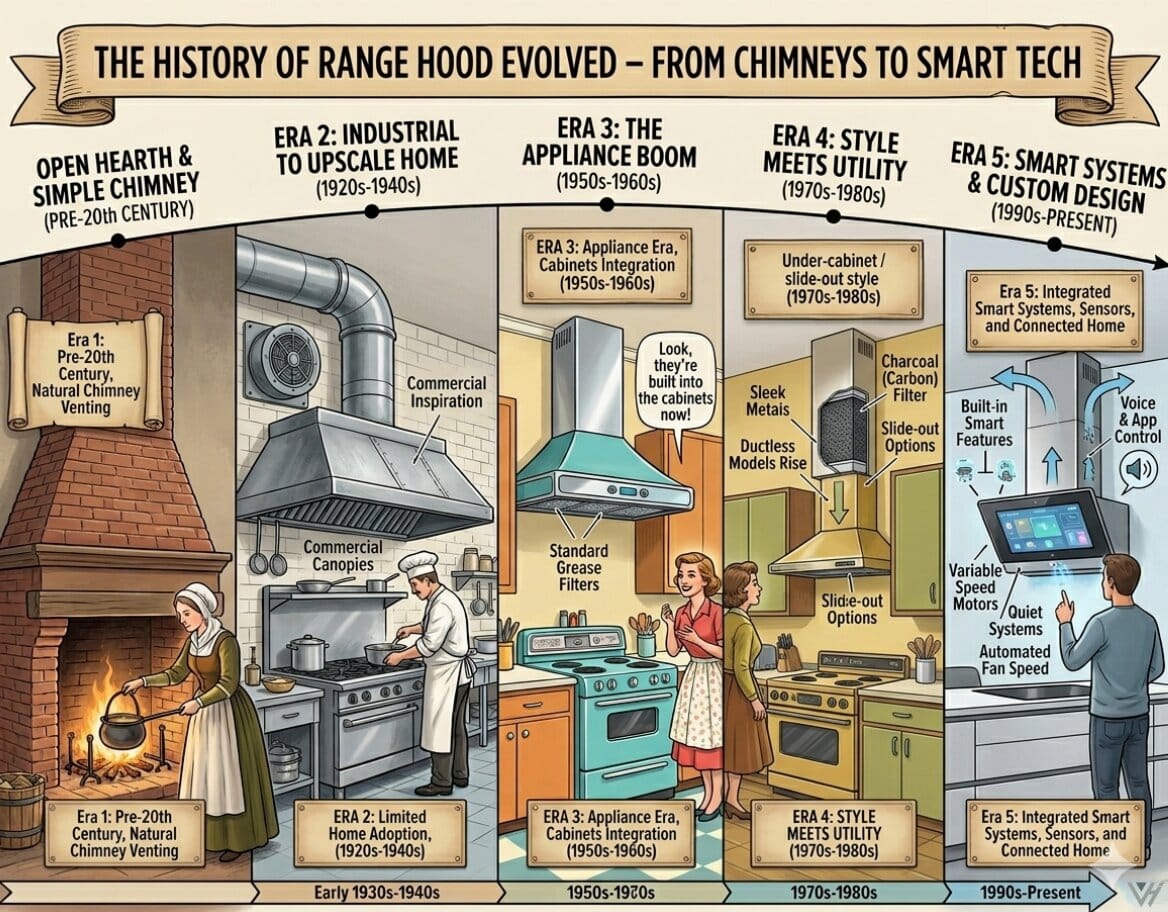
Range Hood Evolution by Decade
1920s to 1940s: The Functional Foundation
During this era, kitchen layouts became more defined, and ventilation shifted from a luxury to a necessity, especially in city homes. Drawing inspiration from commercial kitchens, early residential hoods prioritized function over form. Key features of this period included:
- Limited use in most homes, with greater adoption in upscale or urban residences
- Basic metal canopies paired with simple exhaust fans
- Wall-mounted units providing passive or mechanical ventilation
1950s to 1960s: The Appliance Era
The post-war boom changed how people lived and cooked. Range hoods became more accessible as homes filled with modern appliances. Key developments included:
- Standard sizing for better fit and installation
- Integration into kitchen cabinetry for a built-in look
- Mass adoption in suburban housing developments
1970s to 1980s: Design Meets Utility
Open kitchen layouts demanded appliances that were both efficient and visually appealing. This period brought the rise of ductless models and more stylistic options. Highlights from these decades:
- Multiple fan speeds and improved lighting became common
- Brushed metals and sleek finishes gained popularity
- Charcoal filters made ductless designs more viable
- Under-cabinet and slide-out options became widely available
1990s: Innovation and Efficiency
With energy-saving and noise reduction taking center stage, manufacturers focused on better performance and quieter operation. Common features introduced during this period:
- Variable-speed motors for better control
- Quieter fan systems with improved insulation
- Designs that blended into high-end kitchen aesthetics
2000s to Today: Smart Features and Custom Looks
Today’s kitchens are a blend of technology and style. Modern range hoods are built to connect with smart systems and adapt to cooking needs in real time. Innovations include:
- Touchscreen and remote control options
- Wi-Fi enabled models with app support
- Minimalist styles in glass, matte finishes, and custom panels
- Heat and smoke sensors for automatic activation
Changing Designs and Styles through the Years
As kitchens became central to home design, range hoods followed suit. Their look shifted from utilitarian to decorative.
- Retro styles: Curved metal forms and riveted finishes from mid-century models
- Hidden models: Seamlessly integrated into cabinets or islands
- Modern finishes: Popular choices include matte black, brushed steel, and glass
Today’s hoods serve a dual purpose. They improve air quality while elevating the look of your kitchen.
Milestones in Range Hood Technology
The technology behind range hoods has steadily improved. Key breakthroughs include:
- Variable fan speeds: Offering control for different cooking tasks
- Advanced filtration: Grease traps, baffle filters, and charcoal elements
- Ductless systems: Suitable for apartments or spaces without external venting
- Connected features: Voice control and app integration
These advancements help homeowners cook safely and comfortably, no matter the kitchen size or layout. In fact, a peer-reviewed study published by the National Institutes of Health (NIH) confirms that mechanical ventilation systems, including modern range hoods, play a critical role in reducing airborne cooking pollutants and protecting long-term indoor air quality. This makes investing in the right range hood not just a design decision, but a health one.
Want to Learn about Today’s hood Components? Check out this detailed guide on Every Rang hood Component and Part Explained.
Commercial Influence on Domestic Kitchens
Many home kitchen trends started in restaurants. Commercial hoods introduced features that later appeared in consumer models.
- Fire suppression systems: Some high-end home hoods now include these features
- High-capacity blowers: Inspired by the need for quick, powerful ventilation in busy kitchens
- Pro-style aesthetics: Industrial looks became popular in modern residential kitchens
Conclusion
Range hoods have come a long way. From open chimneys to smart appliances, their development mirrors changes in how we cook and live. They’ve gone from purely functional tools to statement pieces in modern homes.
To learn more, explore our related guides on types of range hoods available today, whether you even need a range hood, how today’s range hood actually works, and how to choose the right hood for your kitchen. These resources help you make informed decisions for better air quality and smarter kitchen upgrades.