
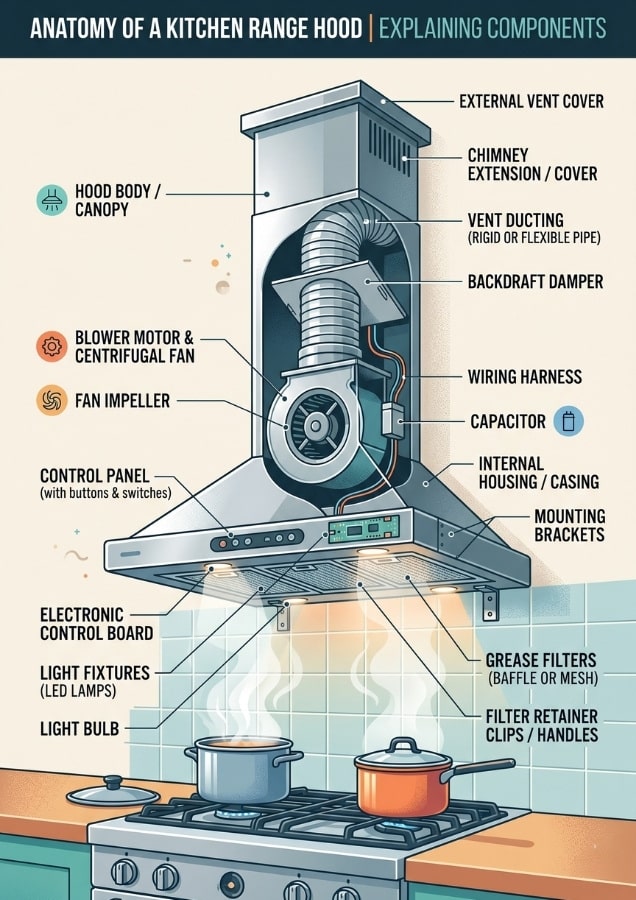
A kitchen range hood is one of the hardest-working appliances above your stove, yet most homeowners know surprisingly little about what is actually inside it. Understanding range hood components help you install correctly, maintain with confidence, and make sense of the specifications you will encounter. Here, We will introduce every major part of a range hood and explain clearly what it does.
Range Hood Components at a Glance
Component | Primary Function | Key Spec |
Blower / Fan | Moves air out of the kitchen | CFM rating |
Filters | Captures grease, absorbs odors | Type and cleaning frequency |
Grease Tray | Collects draining grease | Empty every 2 to 4 weeks |
Control Panel | Operates speed, lighting, timer | Number of speed settings |
Lighting System | Illuminates the cooktop | Wattage and bulb type |
Ductwork | Channels exhaust air outside | Diameter and material |
Canopy and Body | Captures smoke at the source | Coverage width |
Chimney / Flue | Conceals ductwork above canopy | Height adjustability |
Damper | Blocks outdoor air backflow | Spring-loaded or motorized |
HVI Certification | Validates performance claims | Verified CFM and sone ratings |
The Main Components of a Range Hood
In this section, we’ll introduce each primary part that makes up a typical range hood, explaining its function and how it fits into the overall ventilation system. We’ve organized the components in order of how central they are to the hood’s operation, starting with the motor that drives everything and working outward to the structural and certification elements.
Let’s dive deeper into each component.
1. The Blower or Fan
The blower, also called the fan or motor, is the heart of your range hood. It pulls smoke, steam, and cooking odors from above the cooktop and either expels them outdoors through ductwork or pushes air through filters before recirculating it back into the kitchen.

Blowers come in three configurations: internal blowers are built directly into the hood housing, external blowers are mounted outside the home on an exterior wall or roof, and inline blowers sit within the ductwork between the hood and the exterior vent.
Airflow is measured in cubic feet per minute (CFM), representing the volume of air the motor can move per minute. Noise is measured in sones, a unit of perceived loudness where a lower number reflects quieter operation. A sone rating below 3 at medium speed is generally comfortable for kitchens that open into living or dining areas.
2. Filters: Grease and Odor Management
Filters are the range hood’s first line of defense against airborne grease and cooking odors. They protect the blower motor from grease buildup, maintain indoor air quality, and determine how frequently the hood requires cleaning.

There are three main filter types. Baffle filters are made from stainless steel and channel airborne grease into a drip tray through a series of angled passages. Mesh filters are flat aluminum or stainless steel screens that trap grease as air passes through them. Charcoal filters, used exclusively in ductless range hood, absorb cooking odors through activated carbon rather than capturing grease.
|
Filter Type |
Cleanable |
Replacement Frequency |
|---|---|---|
|
Baffle |
Yes, dishwasher-safe |
Rarely needed |
|
|
Yes, dishwasher-safe |
Every few years |
|
Charcoal |
No |
Every 3 to 6 months |
3. The Grease Tray
The grease tray, sometimes called a drip cup or drip tray, is a small removable container that sits beneath the filters and collects grease that drains off during cooking. It functions separately from the filter itself and is one of the most commonly overlooked components during routine maintenance.

Most grease trays slide out from the hood housing without tools and are safe to hand-wash with warm, soapy water. Because a full or overflowing tray presents a fire hazard, it requires emptying and wiping every two to four weeks under regular cooking conditions.
4. Control Panel and Speed Settings
The control panel is the interface for managing the range hood’s operation. It controls fan speed, lighting, and any additional functions the hood offers. Panel types range from simple mechanical knobs and push-button switches to electronic displays and full touchscreen interfaces.

Range hoods typically offer between two and four speed settings. A fan delay feature, found on many models, keeps the hood running for a few minutes after cooking ends to clear residual odors from the kitchen. Timer and auto shut-off functions are also common on electronic and touchscreen panels.s needed to ensure consistent visibility. Typical range hood bulbs range from 25 to 50 watts.
5. Lighting System
The lighting system illuminates the cooktop surface during cooking. It serves a practical safety function by improving visibility at the stove and also contributes to the overall kitchen ambiance.

LED lights are standard in most modern range hoods. They consume less energy, produce minimal heat, and have a significantly longer lifespan than older bulb types. Halogen lights, found in some models, produce a brighter and warmer light. Typical range hood bulbs run between 25 and 50 watts, and most are straightforward to replace when they burn out.
6. Ductwork and Ventilation Path
Ductwork is the system of tubing that carries exhaust air from the blower to the exterior of the home. In ducted range hood installations, it is the ventilation path that determines how effectively the blower’s rated CFM translates into real-world performance.

Smooth rigid metal duct in a 6 to 8 inch diameter is standard for residential range hood installations. It creates the least air resistance and is straightforward to maintain. Every bend or elbow in the duct run reduces airflow, so shorter, straighter runs perform better. For high-CFM hoods above 400 CFM, some jurisdictions require a make-up air system that introduces fresh air into the kitchen to replace what the hood exhausts, preventing pressure imbalances.
7. Range Hood Canopy, Body, and Chimney
The canopy is the visible lower section of the range hood, positioned directly above the cooktop. It funnels rising smoke, steam, and grease-laden air toward the filters and blower. Canopy width is a key factor in capture efficiency, with wider canopies covering more of the cooking surface.

Canopies are most commonly constructed from stainless steel, though tempered glass and custom cabinetry panels are also available depending on the hood model and kitchen design. On wall-mounted and island hoods, the chimney (also called the flue or flue cover) is the vertical column that runs from the top of the canopy up to the ceiling, concealing the ductwork inside. Most chimneys are made of two telescoping sections that adjust to fit different ceiling heights.
8. Dampers and Check Valves
A damper, also called a backdraft damper or check valve, is a flap or gate installed within the ductwork or at the exterior vent cap. Its function is to prevent outdoor air from flowing back into the kitchen through the exhaust duct when the hood is not in operation.

Dampers are typically spring-loaded or gravity-operated. They open automatically when the blower pushes air through and close when the fan stops. Some range hoods include a built-in damper near the blower housing. Others rely on a damper at the exterior wall cap. Grease buildup can cause dampers to stick over time, so checking that yours moves freely is part of routine hood maintenance.
9. HVI Certification
The Home Ventilating Institute (HVI) is an independent organization that tests and certifies the performance of residential ventilation products, including range hoods. When a range hood carries an HVI certification, its CFM and sone ratings have been verified under standardized conditions rather than self-reported by the manufacturer.
This distinction matters because manufacturers testing a hood without filters or attached ductwork will record higher figures than what the product delivers in a real kitchen installation. HVI-certified ratings reflect actual performance under consistent testing methodology, giving consumers and installers a reliable basis for comparison.
Conclusion
Every component in a range hood has a specific job, and the system only works well when all parts are properly matched and maintained. The blower drives the airflow, the filters protect it, the ductwork delivers on the blower’s rated performance, and the damper ensures that airflow moves in one direction only. Understanding how these parts connect gives you a clearer picture of how the appliance works as a whole.
FAQs
What are the main components of a range hood?
A range hood consists of a blower or fan, grease filters, a grease tray, a control panel, a lighting system, ductwork, a canopy and body, a chimney or flue on wall-mounted and island models, and a backdraft damper. Together, these parts form a complete kitchen ventilation system.
What is CFM in a range hood?
CFM stands for cubic feet per minute. It measures the volume of air the blower can move in one minute and is the primary indicator of a range hood’s ventilation capacity.
What does a range hood damper do?
A damper prevents outdoor air, odors, and insects from entering the kitchen through the exhaust duct when the range hood fan is off. It opens automatically when the blower runs and closes when it stops.
What is HVI certification for range hoods?
HVI certification means a range hood’s CFM and sone ratings have been independently tested and verified by the Home Ventilating Institute under standardized conditions. It confirms the published specifications reflect real-world performance.
What is a sone rating?
A sone is a unit of perceived loudness used to measure range hood noise. The lower the sone rating, the quieter the hood operates at a given speed setting.
What is the difference between a ducted and a ductless range hood?
A ducted range hood vents cooking air directly outside through ductwork. A ductless range hood filters air through charcoal and recirculates it back into the kitchen. Ducted hoods are more effective at removing airborne particles and moisture from the kitchen.
Don’t Miss These Guides to Check Out: