
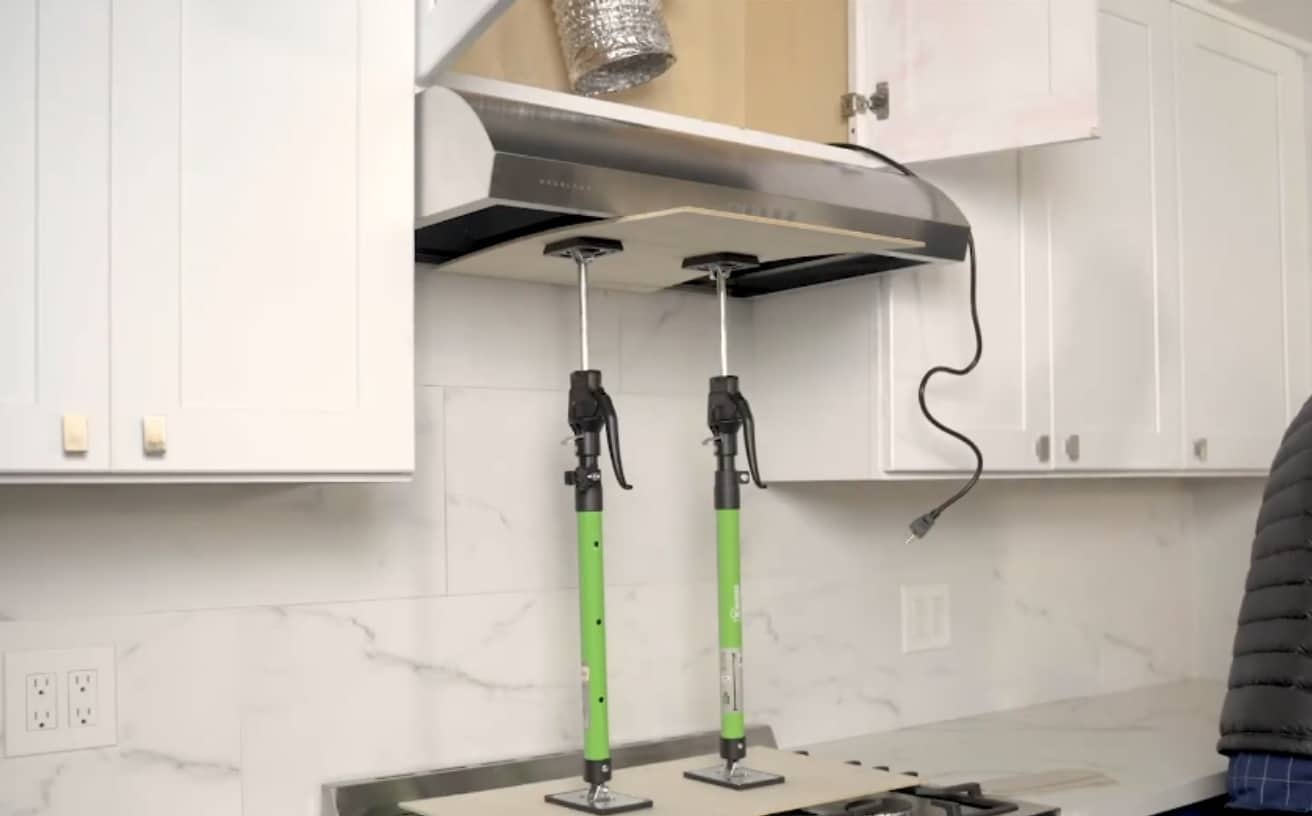
Installing an under-cabinet range hood takes 2-4 hours and requires basic carpentry and electrical skills. The deciding factor in most under-cabinet installations is not the mounting: it is whether a proper electrical circuit and junction box are already positioned correctly above the cabinet.
Here we will show you how to install an under cabinet range hood, both ducted (vented to the exterior) and ductless (recirculating) types. The mounting and wiring process is identical for both. The paths split only at the ventilation stage. Work through the shared sections first, then jump to whichever method applies to your kitchen.
Before You Start: What to Know About Under Cabinet Range Hoods
An under-cabinet range hood mounts directly to the underside of a wall cabinet, sitting flush or semi-flush above the cooktop. It is the most common residential hood type and the most manageable to install. Two decisions must be made before a single screw goes in: ducted or ductless, and whether the hood’s CFM rating matches your cooktop’s output. Before we get into the installation steps, two decisions need to be settled first.
Identify Your Ventilation Setup
The fastest way to determine your installation type is to look above the cabinet or inside the soffit directly above the cooktop. If there is an existing duct penetration leading to the exterior, you have a ducted setup ready to use. If there is no penetration and running new ductwork through the wall or soffit is not feasible, ductless is the practical default.
Many under-cabinet hoods ship duct-ready but include a recirculation kit for ductless conversion. Check your model’s manual before purchasing anything extra; the kit may already be in the box. Ducted is the right choice whenever the layout allows a direct path to an exterior exit point. See our ducted vs. ductless range hoods guide for a full breakdown of both systems.
Feature | Ducted | Ductless |
Venting method | Exhausts outside via ductwork | Recirculates through charcoal filter |
Installation complexity | Moderate (duct routing required) | Lower (no exterior penetration) |
Ventilation performance | Superior | Good for light to moderate cooking |
Ongoing maintenance | Remove and clean grease filters every 4-6 weeks | Change charcoal filter quarterly for regular cooking; stretch to 6 months for light use |
Best for | Kitchens with exterior wall/soffit access | Kitchens where venting outside is not feasible |
CFM Requirements for Under-Cabinet Hoods
CFM selection should track cooktop output, not kitchen size. What matters is the total BTU load your cooktop puts out at full use. For electric cooktops, the minimum practical rating is 200 CFM. For gas ranges, plan for 400 CFM or more.
Most residential under-cabinet hoods are rated between 200 and 600 CFM, which is sufficient for the majority of home cooktops. On noise: under-cabinet hoods typically run louder than wall-mount units at equivalent CFM because of their compact motor housing. A unit rated at 2-3 sones on high is considered acceptable for this type. Anything above 4 sones will be noticeably loud during daily cooking. Factor this into your purchase decision if you have not bought the hood yet, and check our guide on calculating the CFM you need if you are unsure about sizing.
Tools and Materials You’ll Need
With your ventilation type confirmed and CFM matched to your cooktop, the prep decisions are behind you. Before the hood goes up, gather everything on the list below. Stopping mid-install to source a missing part is the most common cause of avoidable delays, and once duct cuts are made, pausing is not ideal.
|
Tools |
Materials |
|---|---|
|
Drill and bits |
Mounting hardware (usually included) |
|
Hole saw (3.25″ for standard duct collar) |
Duct transition piece (if needed) |
|
Jigsaw (for soffit cuts) |
Foil HVAC tape |
|
Stud finder with AC detection mode |
Wire nuts |
|
Level |
Junction box (if not pre-wired) |
|
Wire stripper |
Wall cap or roof cap (ducted only) |
|
Non-contact voltage tester |
Charcoal filter (ductless only) |
|
Tape measure and pencil |
Exterior-grade caulk (ducted only) |
|
Cabinet jack or prop |
Fender washers or toggle bolts (if cabinet floor is thin) |
One check before cutting anything: confirm whether your hood uses a top-exit or rear-exit duct configuration. Top-exit routes the duct vertically through the cabinet above; rear-exit sends it horizontally through the wall behind. The knockout location on the hood body tells you which. Look before you pick up a hole saw.
Mounting the Range Hood Under the Cabinet
With your tools and materials in order, we move into the installation. The mounting process is the same whether you are going ducted or ductless. Get this right and everything downstream is manageable.
Step 1: Mark the Mounting Position and Centerline
Measure the width of the cooktop and find its center point. Transfer that centerline up to the underside of the cabinet using a plumb line or level. This is the reference point for the hood’s position. The hood must center over the cooking surface, not over the cabinet doors or backsplash tile.
Use the mounting template included with the hood to mark screw hole positions on the cabinet underside. If no template is included, hold the hood body up to the cabinet and mark through the mounting holes directly. Mark the centerline on the hood body too and align them before committing to any holes.
Mount the hood 24-30 inches above an electric cooktop and 24-36 inches above a gas cooktop. Stay within the manufacturer’s specified range. Too high and suction drops significantly; too low and you are creating a heat hazard.
Step 2: Cut the Duct Knockout or Rear Exit (Ducted Only at This Stage)
If you are going ducted, cut the duct knockout before mounting the hood. Most under-cabinet hoods have a pre-scored knockout on the top panel for a vertical exit, or a rear-panel knockout for a horizontal exit. Cut it out with a jigsaw or hole saw and confirm the size matches your duct collar (typically 3.25″ x 10″ rectangular or 6″ round).
Do this on the ground, not overhead. Cutting a knockout while the hood is already bolted to the cabinet is awkward and risks damaging the motor or controls.
Step 3: Lift and Bolt the Hood to the Cabinet
Under-cabinet hoods typically weigh 35-55 lbs. A second person makes this easier, but a solo install is manageable with a prop: a cabinet jack, a stack of books, or a purpose-cut piece of lumber set on the cooktop surface to hold the hood at height while you drive the screws.
Drive screws into the cabinet floor at the marked positions. If the cabinet floor is particleboard (common in stock cabinetry), use fender washers behind the screw heads to distribute the load. Particleboard strips easily under point pressure, and a hood that works its way loose over time is a safety problem. Toggle bolts are the right call if the material is too thin to hold a wood screw reliably.
Check level on both axes before fully tightening. A hood that is even slightly tilted will have uneven grease drainage across the filter surface.
Step 4: Connect the Electrical Wiring
Turn off the breaker. Verify dead at the junction box with a voltage tester. Never rely on the breaker position alone.
Most under-cabinet hoods wire directly to a junction box inside the cabinet above, or come factory-fitted with a standard 120V plug. For hardwired units, connect conductors by color: hot (black) to hot, neutral (white) to neutral, and the bare copper or green wire to the grounding terminal. Cap each pair with a wire nut and fold the connection back toward the wall before closing the box. Tug each connection to confirm it is secure before closing the box.
If there is no existing circuit or junction box above the cabinet, stop here. Running new electrical rough-in is a job for a licensed electrician. Attempting it without one is a code violation in most jurisdictions and a genuine fire risk. Once the circuit is in place, the wiring connection itself is straightforward DIY work.
If you are going ducted, continue directly to the next section. If you are going ductless, skip ahead to the ductless installation section below.
Ducted Under-Cabinet Range Hood Installation
If you have made it here, Steps 1 through 4 are done and your hood is secured. Here we cover the duct run: connecting the hood’s exhaust outlet to an exterior wall cap through rigid or semi-rigid aluminum ductwork.
Step 5: Plan Your Duct Route
The shortest, most direct route between the hood and the exterior wall is always the right route. Each directional change in the duct run degrades the airflow that ultimately reaches the exterior cap. A single tight elbow can absorb a meaningful percentage of the hood’s rated output; on a 400 CFM unit routed through two sharp turns, the actual ventilation rate at the cap can fall well short of what the cooktop requires, a shortfall that shows up as lingering odors and smoke during cooking.
For most under-cabinet installations, the duct route runs one of two ways: top exit through the cabinet above, up through the soffit, then out through the exterior wall cap; or rear exit directly through the wall immediately behind the hood. In our experience, the rear-exit route is the more efficient of the two when the kitchen layout allows it. Map the full route before cutting anything.
Step 6: Cut the Cabinet and Soffit for Ductwork (If Required)
If the duct must travel through a sealed soffit, cut access holes through the cabinet floor and soffit ceiling. Use a jigsaw. Before cutting, run a stud finder in AC-detection mode across the soffit. Live electrical wires inside a soffit are common, and cutting through one is a serious hazard.
Tap the soffit surface before cutting. A hollow sound means the cavity is open and the duct run is simple. A solid sound means structural blocking is present. If the soffit is blocked, re-routing the duct to exit directly through the exterior wall behind the hood is almost always easier than cutting through blocking material.
Step 7: Connect and Secure the Ductwork
Connect the first duct section to the hood’s exhaust collar. Use a transition piece if the collar is rectangular and your duct is round. Seal every joint with foil HVAC tape, not cloth duct tape. The cloth-backed product often labeled as duct tape degrades in this application: cooking heat and grease vapor break down its adhesive before the first year of cooking is complete. Aluminum foil tape maintains its bond regardless of temperature and is the correct choice here.
Use rigid aluminum duct throughout the run. It is more efficient than flex, holds its shape, and is far easier to clean. Never use sheet metal screws inside the duct. The exposed screw tips catch grease, and a grease-laden obstruction inside a metal duct is a fire hazard.
Step 8: Install the Exterior Wall Cap
Drill the exterior opening to the exact duct diameter. Feed the cap spigot through from outside, set the flange flat against the wall, and fasten it with weather-resistant screws into the wall framing. Finish with exterior-grade caulk in a single continuous bead around the flange, overlapping at the start point. Test the damper flap before the caulk sets. Activate the unit briefly before the caulk sets and confirm the damper lifts cleanly under operating airflow. Shut the fan off and watch the flap return to the closed position without hesitation. Any partial-close position means the damper pivot needs adjustment before you finish the installation.
Before mounting, check the wall cap for a wire mesh insert or screen behind the damper. These are typically included as pest barriers, but they fail at that function quickly in a range hood application. A grease-loaded screen drops measurable CFM at the cap and can reduce exhaust to a fraction of the hood’s rated output.
Step 9: Install the Grease Filter and Test the System
Snap the baffle or mesh grease filter into position. Restore power at the breaker. Run the fan on its highest setting and walk outside to confirm airflow at the wall cap. The damper flap should swing open visibly.
Back inside, hold a paper towel near the hood face. It should pull firmly toward the filter face. Run your hand along the duct joints. Any air escaping at a seam means that joint needs additional foil HVAC tape. Every unsealed duct joint inside the cabinet drips grease onto adjacent surfaces, a maintenance problem that becomes a fire hazard as the buildup grows. Do not defer this: seal every joint fully during the initial installation before the cooktop goes back into service.
That completes the ducted installation. If you are setting up a ductless unit, the section below covers the recirculation setup from filter fitting to final test.
Ductless Under-Cabinet Range Hood Installation
If you completed the mounting steps and are setting up a ductless unit, skip the ducted section above and start here. The hood is secured, the wiring is done, and there is no duct run ahead. What remains is recirculation-specific: fitting the charcoal filter and confirming the damper is configured correctly before the hood goes into service.
Step 5: Install the Charcoal Filter
With the hood mounted and wired, the charcoal filter is the next component to fit before the unit goes into service. Locate the charcoal filter slot, typically positioned immediately behind or directly adjacent to the grease filter. Consult the diagram in your model’s manual before fitting it. The slot positions are not always obvious, and the grease filter and charcoal filter have different functions and are not interchangeable. Fitting the wrong filter in the wrong slot is a common mistake at this stage.
Slide or clip the charcoal filter into its designated slot until it seats fully. A filter that is partially seated will not sit flush against the housing, and misaligned contact between the filter and the airflow path reduces its effectiveness. Check the fit from both sides before moving to the next step.
Step 6: Confirm the Recirculation Damper Is Open (Not Blocked)
With the charcoal filter seated, do not restore power yet. This is the most commonly missed step in a ductless under-cabinet installation and the reason most ductless hoods get returned as defective when they are actually just misconfigured. Some under-cabinet hoods ship with the internal recirculation damper in ducted mode or partially blocked by a cover panel intended for ducted use.
Check the top of the hood body. For ductless operation, the top exhaust port must either be sealed with the provided cover plate, which redirects airflow back through the filter internally, or left open per your model’s specific recirculation design. The manufacturer’s ductless conversion instructions will tell you exactly what position is correct. Do not assume.
Step 7: Run the Fan and Check Recirculation
With the damper confirmed, restore power at the breaker. Run the fan on the highest speed. Ductless units push filtered air back into the kitchen, so there is no exterior cap to check. Hold your hand at the recirculation vents, typically located at the top of the hood body or on its sides, and confirm warm air is exiting.
If the fan runs normally but no air exits at the recirculation vents, the conversion kit is not configured correctly. The most common cause is the ductless cover plate fitted over the wrong port. Return to Step 6 and work through the manufacturer’s instructions again before concluding the unit is defective.
Common Under-Cabinet Range Hood Installation Mistakes
With the hood mounted, wired, and set up for either ducted or ductless operation, let’s make sure you have not carried any of the most common installation mistakes into the finished job. Here is what to check.
Conclusion
An under-cabinet range hood installed correctly is a long-term fixture in a working kitchen. You have worked through the pre-installation decisions, the shared mounting steps, and whichever ventilation path your kitchen called for. If the duct joints are sealed, the mounting height is within spec, and the filters are seated correctly, the hood is set up to perform at its rated output from the first use.
The two things most likely to degrade that performance over time are filter maintenance and duct integrity. Clean the grease filters every four to six weeks under regular cooking load. If you installed a ductless unit, replace the charcoal filter on schedule. For ducted installations, inspect the wall cap damper annually and confirm it is opening and closing cleanly.
If anything from the installation process is still not clear, the FAQs below cover the questions we see most often on this topic.
Frequently Asked Questions
How high should an under-cabinet range hood be installed above the stove?
Install an under-cabinet range hood 24 to 30 inches above an electric cooktop and 24 to 36 inches above a gas cooktop. The exact height depends on the manufacturer’s specification, so check the installation manual before mounting. Too high reduces suction effectiveness; too low creates a heat clearance hazard. Most building codes require a minimum of 24 inches above any cooking surface regardless of hood type.
Can I convert a ducted under-cabinet range hood to ductless?
Yes. Most ducted under-cabinet range hoods can be converted to ductless operation using a recirculation kit, which typically includes a charcoal filter and a cover plate to block the top exhaust outlet. The kit is either included with the hood at purchase or available separately from the manufacturer. Check your model’s manual to confirm compatibility before ordering, as not all models support conversion.
What size duct does an under-cabinet range hood use?
Most residential under-cabinet range hoods use a 3.25″ x 10″ rectangular duct or a 6″ round duct. The specific size depends on your model’s CFM rating and the duct collar dimensions listed in the installation manual. Hoods rated above 400 CFM typically require 6″ or 7″ round duct for adequate airflow. Undersizing the duct creates back pressure that reduces exhaust performance and increases operating noise.
Do I need an electrician to install an under-cabinet range hood?
Where a dedicated circuit and properly positioned junction box are already installed inside the cabinet above the cooktop, the wiring step is manageable for most experienced DIYers. If no circuit exists, or if the hood requires hardwiring with no existing junction box, hire a licensed electrician to run the circuit first. Turn off the breaker and verify the line is dead with a voltage tester before making any wiring connections, every time, without exception.
Why is my under-cabinet range hood so loud after installation?
In our assessment, undersized or over-bent ductwork is the most common root cause of excess noise after installation. The other two causes are a loose duct joint vibrating under airflow and a restricted wall cap damper that is not opening fully. Ductless units also run louder than ducted equivalents at the same CFM, because recirculating air through a charcoal filter creates more resistance than venting outside. Check duct sizing first, then inspect every joint and the wall cap damper.
How do I know if my ductwork is the right size for my range hood?
Match the duct diameter to the hood’s exhaust collar and maintain that diameter for the full run. For hoods rated under 400 CFM, 6″ round or 3.25″ x 10″ rectangular duct is standard. For 400-600 CFM hoods, use 6″ or 7″ round duct. The exhaust collar diameter is the floor the duct must maintain from that point to the cap. A reducer anywhere in the run acts as a constriction: exhaust backs up behind it, the fan works harder to push through, noise climbs, and the motor’s service life shortens. Match collar to cap at the same diameter throughout.
Can I vent an under-cabinet range hood through the roof instead of the wall?
Yes. Roof venting is a viable alternative when exterior wall access is not available. The duct travels vertically through the cabinet, soffit, and ceiling into the attic, then exits through a roof cap. Use insulated duct through any unconditioned attic space to prevent condensation from forming inside the duct and dripping back through the hood. Roof cap installation requires proper flashing around the penetration. If you are not experienced with roofing work, engage a roofer for that portion of the job.
Explore More Under-Cabinet Range Hood Guides: