

If you have ruled out an over-the-range microwave and you are weighing your real ventilation options, the ducted vs ductless range hood question is likely where the decision sits now. In this guide, we compare both systems across the factors that actually drive the choice: your cooking style, your kitchen layout, and what your walls and ceiling realistically allow.
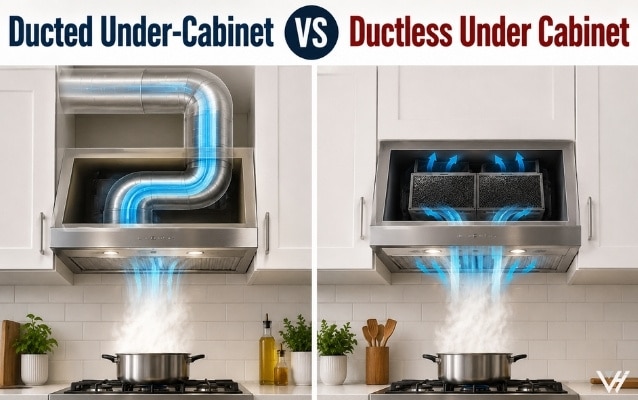
A ducted hood vents air completely outside the home through a wall or roof exit. A ductless hood filters the air through charcoal and mesh filters and returns it to the kitchen. Based on our evaluation, ducted range hoods deliver stronger ventilation performance; ductless range hoods offer installation flexibility. Where you land depends on your kitchen’s actual constraints, not a preference list.
Ducted vs Ductless Range Hood – Quick Verdict (Start Here)
Most buyers get this comparison wrong because they focus on features before checking what their kitchen actually supports. Start there first. Once you know what your layout allows, the right hood type becomes obvious.
Choose Ducted If You Want:
- Maximum smoke, grease, and odor removal. Ducted hoods push air completely outside, so contaminants leave the home rather than being filtered and returned.
- Better performance for heavy cooking. If you regularly fry, grill indoors, or cook at high heat, ducted ventilation handles what ductless systems cannot.
- Better long-term air quality. No recirculation means heat, humidity, and fine grease particles clear out of your kitchen instead of building up over time.
Related Reading: Ducted Range Hood Explained (When It Makes Sense)
Choose Ductless If You Want:
- Simple installation with no structural work. Ductless range hoods need no ductwork, no wall penetrations, and no modifications to your home.
- An apartment or rental-friendly option. When cutting through walls or ceilings is not permitted, ductless is often the only practical choice available.
- Lower upfront cost. Both the unit and installation are cheaper than a ducted setup, particularly in kitchens with no existing ductwork.
Related Reading: Ductless Range Hood Explained (When It Would be an Option)
Side-by-Side Comparison (Performance, Cost, Installation)
When comparing between ductless and ducted range hood, three factors matter most: performance ceiling, installation requirements, and total cost of ownership. The table below puts all three side by side so you can evaluate them together.
Factor | Ducted | Ductless (Recirculating) |
Venting Method | Exhausts air outside via ductwork | Filters and recirculates air back into kitchen |
Smoke Removal Efficiency | Excellent; removes 100% of captured smoke | Moderate; reduces visible smoke but recirculates fine particles |
Odor Control | Superior; odors exit the home completely | Good with fresh charcoal filters; performance drops as filters age |
Grease Capture | High; baffle or mesh filters capture grease before exhaust | High capture at filter level, but grease stays in the unit |
Installation Difficulty | Moderate to high; requires duct path, wall or ceiling penetration | Low; mount, connect power, done |
Maintenance Frequency | Low; clean filters every 1 to 3 months; inspect ducts annually | High; charcoal filters need replacement every 3 to 6 months |
Noise Levels | Lower at high CFM with a short, straight duct path; louder with multiple bends or undersized duct | Generally louder at equivalent settings due to motor resistance pushing air through filters |
Upfront Cost | Higher ($150 to $800+ appliance; $200 to $500+ installation) | Lower ($80 to $500 appliance; $50 to $150 installation) |
Long-Term Cost | Lower; no consumable filters | Higher; ongoing charcoal filter replacement |
For verified CFM and sone performance data, the Home Ventilating Institute explains why kitchen range hoods matter for indoor air quality and maintains a certified product directory used across the industry.
The Differences Between Ducted and Ductless Hoods That Really Matter
Spec sheets only go so far. The real performance gap we found between a ducted vs ductless range hood shows up in daily use, in how well your kitchen clears after a heavy meal, and in whether you are still smelling last night’s dinner the next morning.

1. Smoke and Odor Removal (Core Performance Gap)
A ducted range hood pulls smoke, steam, and airborne grease through the capture area and exhausts it outside through a duct that exits at a wall, roof, or soffit. The air leaves the building. Those pollutants do not come back.
A ductless hood passes air through a mesh or baffle grease filter, then through an activated charcoal filter, and returns it to the kitchen. The charcoal absorbs odor molecules, which is adequate for light cooking. The problem is saturation. As the charcoal fills up between replacements, it stops absorbing and starts recirculating. At that point you are not removing cooking odors, you are just moving them around.
For everyday cooking — pasta, vegetables, simple proteins — a ductless hood holds up fine. If you fry regularly, cook fish, use high heat on a gas burner, or cook with fermented ingredients, a ducted system is a different tool entirely.
2. Air Quality and Heat Management
Ducted range hoods do more than clear smoke. They pull excess heat and moisture out of the kitchen entirely. In smaller or closed-plan kitchens, that matters more than most buyers anticipate. A ductless system filters the air but returns it warm and humid. Run it through a full cooking session and the kitchen gets noticeably hotter and stuffier as the meal progresses.
If your kitchen already runs warm, or your HVAC doesn’t cover it well, a ductless hood makes that problem worse. Ducted ventilation actively brings the temperature down during cooking. Ductless does not.
The EPA guide to indoor air quality and cooking ventilation specifically recommends using a stove hood vented to the outdoors to significantly reduce pollutant exposure during cooking, particularly on gas ranges.
3. Installation Constraints (The Primary Limiter)
More buyers are pushed toward ductless by installation limits than by preference. It is worth knowing which side of that line you are on before you start comparing models.
Ducted installation needs a clear path from the hood to an exterior exit. In a single-story home with an exterior kitchen wall, that is usually a short, manageable run. In a second-floor kitchen, an interior wall layout, or a multifamily building, you are looking at longer duct runs, multiple bends, or penetrations through shared structural elements. Each of those adds cost, cuts airflow efficiency, and may need permits.
Ductless has none of those requirements. If you can mount a wall cabinet, you can install a ductless range hood. That is why it is the default choice for renters, apartment residents, and anyone whose home makes ductwork impractical.
Cost Analysis: Short-Term vs Long-Term Value
Sticker price is a poor basis for this decision. The number that actually matters is what you spend over the life of the appliance, not just at the point of purchase.
Upfront Costs
Ductless range hoods are cheaper on both fronts. The appliance runs $100 to $800 depending on size and brand, and basic installation adds $50 to $150. At the lower end of that range, a ductless setup fits almost any budget.
Ducted hoods cost more upfront. Mid-to-high performance units run $150 to $800 or more. If ductwork already exists, installation adds $200 to $350. If new ductwork needs to be run, that figure climbs to $400 to $1,000 depending on layout, materials, and local labor rates.
Long-Term Costs
Over time the equation flips. Ducted hoods are low-maintenance. Grease filters are washable, and outside of an occasional duct inspection, there are no recurring costs to speak of.
Ductless hoods need regular charcoal filter replacements to stay effective. Good filters cost $15 to $40 per set and need changing every three to six months. Over five years that works out to $150 to $400 in filter costs, not counting any performance drop from filters that get changed late.
Value Over Time
For homeowners who cook regularly and plan to stay put for a few years, ducted installation tends to pay for itself. You avoid filter costs, gain better energy dynamics, and real estate professionals consistently flag proper kitchen ventilation as a visible upgrade to buyers.
For renters or anyone planning to sell within a year or two, the math looks different. Ductless wins on upfront cost, and the short-term filter expense does not erase that gap.
Which One Fits Your Kitchen? (Scenario-Based Decision Guide)
Where and how you cook changes the answer. Here are the most common situations and what we recommend for each.
1. If You Live in an Apartment or Rental
- Best option: ductless or convertible.
Most rental properties prohibit structural modifications, so ducted installation is off the table for most tenants. Even where landlord approval is possible in theory, the logistics rarely make it practical. Ductless is the realistic choice. A convertible model is worth considering if you plan to own a home down the road and want the option to add ductwork later.
2. If You Cook Heavy, Oily, or Spicy Food
- Best option: ducted.
Charcoal filters cannot keep up with high-volume cooking, and they get worse as they age between replacements. If your regular cooking includes deep frying, wok cooking, indoor grilling, or heavy aromatics, a ductless hood will not cut it. You need a ducted system sized correctly for your cooking output.
3. If You Have No Existing Ductwork
- Best option: ductless, or budget carefully for a retrofit.
No existing duct path means the question is financial before anything else. Running new ductwork through a finished home, especially a two-story or complex layout, is a real construction project. Budget $500 to $1,500 or more. If that cost makes sense given how you cook and how long you plan to stay, ducted is worth it. If not, a quality ductless hood is a sound choice, not a consolation prize.
4. If You are Renovating vs Building New
- If renovating: Best option: ductless, unless major structural work is already underway. Retrofitting ductwork in a finished kitchen means opening walls, patching, and repainting — costs that add up fast.
- If building new or doing a gut renovation: Best option: ducted. Run the ductwork now. Integration during initial construction costs a fraction of what a retrofit runs later, and there is no practical reason to skip it at this stage.
5. If You Have a Small or Closed Kitchen
Closed kitchens with limited air exchange expose one real weakness of ductless hoods. As the charcoal filter saturates, recirculated air quality drops faster than it would in an open-plan kitchen with better airflow. In a compact, enclosed space used for regular cooking, ducted ventilation makes a noticeable day-to-day difference. If ducted is not an option, the filter replacement schedule on your ductless hood needs to be treated as non-negotiable.

Installation Reality Check (What Most Buyers Overlook)
In our experience reviewing ventilation setups, the same mistake comes up repeatedly: buyers choose a hood based on performance specs and hit the installation wall afterward. Know what each type requires before you buy, not after.
Ducted Installation Challenges
A clean, efficient duct path is what makes or breaks a ducted installation. The main variables:
- Duct length. The shorter the run from hood to exterior exit, the better. Long runs reduce actual CFM delivered at the hood.
- Number of bends. Each 90-degree elbow costs you airflow. A system with three or four elbows can shed 30 to 40 percent of rated CFM before air reaches the outside.
- Exit point. An exterior wall exit is the simplest. A soffit exit is moderate. A roof exit is the most complex and requires a cap rated for grease-laden air.
- Duct diameter. Undersized duct creates back-pressure, strains the motor, and raises noise levels. Most residential hoods run best on 6- or 7-inch round duct. High-CFM models often need 8-inch or larger.
In older homes, unexpected structural elements, asbestos wrapping, or fire-blocking can add both cost and time.
Ductless Simplicity
Ductless installation is about as simple as range hood installation gets. Mount the bracket, connect power, set the correct clearance height above the cooking surface (24 to 30 inches for electric, 28 to 36 inches for gas), and you are done. No exterior penetrations, no duct sizing calculations, no permits in most jurisdictions. A competent DIYer can handle it in an afternoon.
Convertible Flexibility Drawback
Convertible hoods can run in either mode, which is useful if your living situation may change. But that flexibility only pays off if you plan ahead. If you intend to switch to ducted operation later, think through the duct path before the hood goes up. Repositioning a mounted hood to accommodate a duct route you did not account for is an avoidable problem.
Related Reading: DIY vs Professional Range Hood Installation
Maintenance and Upkeep Differences
Long-term satisfaction with either type comes down to whether the maintenance it requires matches your actual habits, not your intended ones.
Ducted Maintenance
Clean the grease filters every one to three months. Baffle filters go in the dishwasher. Mesh filters soak well in hot water with a degreaser. Once a year, check the duct for grease buildup at bends and near the damper. Grease accumulation in ductwork is a fire hazard. Professional duct cleaning runs $100 to $200 when needed.
Ductless Maintenance
The charcoal filter cannot be cleaned. It needs replacing every three to six months for a regular home cook. Let it go too long and the hood keeps running but stops controlling odors. The sign is simple: cooking smells that stick around after the hood has been on. Grease filters still need the same routine cleaning as any ducted model.
Noise, Efficiency, and Daily Usability
Which Is Quieter in Real Use?
Neither type is inherently quieter. Noise depends on motor quality, CFM rating, and duct design. A ducted system with a short, straight duct path can run very quietly at high CFM. A poorly routed duct creates turbulence and noise regardless of the motor.
Ductless hoods often run louder at equivalent settings because the motor pushes air through filters, which adds resistance.
When comparing models, check sone ratings rather than decibels. Sones reflect perceived loudness at normal operating distance, which is the number that actually matters.
Energy Efficiency
Ducted hoods exhaust conditioned air outside. In winter that means heated air leaving through the duct. High-CFM ducted hoods (generally 400 CFM and above) may require a make-up air system under local building codes to offset negative pressure. Check your local requirements before buying a powerful unit.
Ductless hoods recirculate air, so there is no heat loss through the duct. In colder climates that is a real efficiency advantage, though ongoing filter costs eat into the savings over time.
Everyday Convenience
Ducted hoods are low-maintenance by nature. Keep the grease filters clean and the system runs consistently. Ductless hoods need more active management. Stay on the filter schedule and performance holds up. Let it slide and you will notice it most when you are in the middle of a heavy cook.
Common Buying Mistakes
- Choosing ductless for heavy cooking: Ductless hoods have a performance ceiling. Frequent high-heat cooking hits it fast. No amount of fresh filters closes the gap with a properly ducted system.
- Ignoring CFM requirements: A 400 CFM hood over a six-burner gas range is underspecified regardless of venting type. CFM sizing is a separate calculation. Do not fold it into the ducted vs ductless decision.
- Underestimating installation complexity: Most buyers discover the difficulty of ducted installation after purchasing the unit. Know your duct path before you commit to a model.
- Skipping the long-term maintenance math: Ductless filter replacements are cheap individually. Over three to five years they add up. Run the numbers before you decide, not after.
- Assuming convertible means ducted performance: A convertible hood in ductless mode performs like a ductless hood. The advantage is flexibility, not better ventilation.
Final Verdict: What We Recommend
When we weigh the full picture across performance, installation, cost, and maintenance, the ducted vs ductless range hood decision is not a close call on paper. Ducted ventilation is the stronger system. It removes more, performs more consistently, and costs less to run over time.
The practical question is whether your kitchen supports it. If it does, ducted is the right choice. If it does not, a quality ductless hood maintained on schedule is a legitimate solution, not a fallback.
The performance case for ducted ventilation is very clear, and our recommendation reflects that. But the best range hood is the one that actually gets installed and used in your kitchen. A well-maintained ductless hood beats a ducted system that never made it off the planning stage.
Compare your options:
- Best Ducted Range Hoods (Top Picks)
- Best Ductless Range Hoods (Reviewed)
- Complete Range Hood Buying Guide
FAQs
Is ducted always better than ductless?
In raw ventilation performance, yes. Ducted hoods exhaust air completely outside, which means more smoke, odor, and heat removed. But if your kitchen cannot support ductwork, the performance advantage is irrelevant. For light cooking in a rental or apartment, a quality ductless hood is the right call.
Can ductless range hoods handle heavy cooking?
Not reliably. Charcoal filters work well for everyday cooking but saturate quickly under heavy use. Deep frying, fish, heavily spiced food, and prolonged high-heat cooking will push a ductless hood past its limit, especially as the filter ages. If that describes your cooking, ductless is a workaround, not a proper solution.
Is it worth installing ductwork for a range hood?
For homeowners who cook regularly and plan to stay put, yes. Ductwork installation runs $300 to $1,000 or more depending on complexity, but you get better air quality, no ongoing filter costs, and stronger resale appeal. In a new build or gut renovation, the cost is a fraction of what a retrofit runs later. For renters or short-term owners, the math rarely works out.
How often do ductless filters need replacement?
Every three to six months for a regular home cook. Cook heavily and you are likely looking at closer to three months. Cook lightly and six months is reasonable. Skip the manufacturer’s timer and use a simpler test: if cooking smells linger after the hood has been running, the filter needs to go.
Are convertible range hoods a good compromise?
Yes, but only if you understand what you are getting. A convertible hood runs in ductless mode now and can switch to ducted later when you add ductwork. The flexibility is real and useful if your situation may change. What it does not do is perform between the two. In ductless mode it works like a ductless hood. In ducted mode it works like a ducted hood. The benefit is setup flexibility, nothing more.
Related Comparison Guides You May Check Out:
- Microwave Over Range vs Hood: Which Is Worth Installing?
- Kitchen Hood vs Exhaust Fan: What’s the Real Difference?
- Type 1 Vs Type 2 Hood: Which Applies To Your Kitchen
- Wall-Mount vs. Island Range Hood: Which Do You Need?
- Under Cabinet vs Wall Mount Range Hood Compared
- Range Hood vs Exhaust Fan: What’s the Best for Your Kitchen?