

The filter is the part of a range hood that most homeowners think about least, until it stops working the way it should. A clogged or wrong-type filter reduces airflow, lets grease reach the blower, and makes the entire ventilation system less effective regardless of how powerful the hood is.
Range hood filters are not interchangeable. Each type is designed for a specific ventilation method, cooking load, and maintenance routine. Using the right filter for the hood and cooking setup makes a measurable difference in how well the hood performs and how long it lasts.
We will cover every major type of range hood filter here, how each one works, what it is best suited for, and what maintenance it requires.
3 Main Types of Range Hood Filters
Range hood filters fall into three categories: baffle, mesh, and charcoal. Most ducted hoods use either baffle or mesh filters to capture grease. Ductless hoods use charcoal filters in combination with a grease filter to handle both grease capture and odor removal.
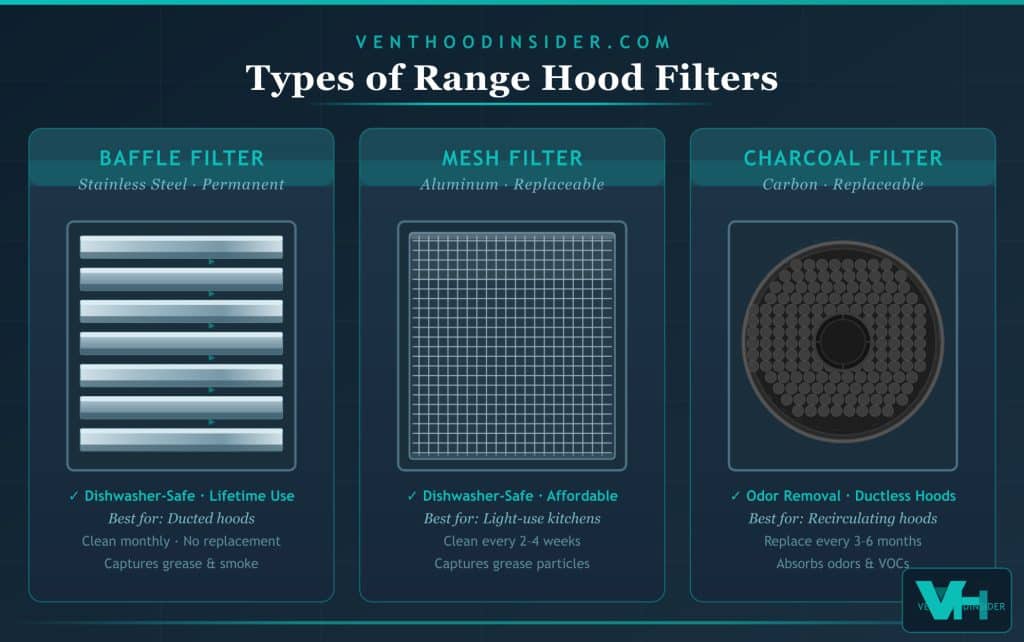
Understanding the difference between them is the first step toward choosing or maintaining the right system.
1. Baffle Filters
- Best for: Gas cooktops, heavy daily cooking, high-CFM range hoods
- Key characteristics: Stainless steel construction, dishwasher-safe, long service life, no replacement required
Baffle filters use a series of angled metal channels to redirect and separate grease from the air stream. As air passes through the filter, it changes direction repeatedly through the channel baffles. Grease particles, being heavier than air, cannot follow those rapid direction changes. They separate from the airflow and collect in the filter body or a drip channel at the base.
The design is effective under heavy use precisely because the channels do not clog the way layered mesh does. Grease collects at the surface and drips down rather than building up inside the filter media. This keeps airflow resistance low even when the filter has accumulated significant grease.

Baffle filters are fabricated from stainless steel and are built to last the life of the hood. They are dishwasher-safe and can be cleaned monthly or as needed without losing effectiveness. There is no replacement schedule, only a cleaning schedule.
Most mid-range and premium range hoods come equipped with baffle filters as standard. They are the preferred choice for gas cooktops and high-BTU burners because they handle high grease loads without significant reduction in airflow performance.
Maintenance Tips: Clean every four to six weeks under normal use. Heavy cooking may require monthly cleaning. Run through the dishwasher or wash by hand with hot water and degreasing detergent.
2. Mesh Filters
- Best for: Light to moderate cooking, electric and induction cooktops, entry-level under-cabinet hood
- Key characteristics: Aluminum or stainless steel layered mesh, dishwasher-safe, more frequent cleaning required
Mesh filters use multiple layers of woven aluminum or stainless steel mesh to capture grease as air passes through. Grease particles adhere to the mesh surface and accumulate within the layered material over time.
They are lightweight, less expensive to produce than baffle filters, and found on most entry-level range hoods as a standard component. For light to moderate cooking on electric or induction cooktops, mesh filters perform adequately and are straightforward to maintain.

The limitation appears under heavier use. Mesh filters clog faster than baffle filters because grease builds up within the mesh layers rather than collecting at a surface and draining away. As the filter clogs, airflow resistance increases, reducing the effective CFM of the hood and putting additional strain on the blower motor. A mesh filter that is overdue for cleaning is one of the most common reasons a range hood underperforms.
Mesh filters are dishwasher-safe, but they need cleaning more frequently than baffle filters to stay effective, requiring attention every two to four weeks under regular use rather than monthly.
Maintenance Tips: Clean every two to four weeks under regular use. Soak in hot water with dish detergent or run through the dishwasher. Do not allow grease to harden in the mesh layers, as saturated filters are more difficult to clean effectively.
3. Charcoal (Carbon) Filters
- Best for: Ductless (recirculating) range hoods, apartments, rentals, kitchens without exterior venting
- Key characteristics: Activated carbon media, absorbs odors, non-washable, requires scheduled replacement
Charcoal filters, also called carbon filters, are used exclusively in ductless recirculating range hoods. They do not capture grease; that function is handled by a separate grease filter (baffle or mesh) installed in the same hood. The charcoal filter’s purpose is odor removal.
As air passes through the activated carbon media, odor molecules bond to the carbon surface and are removed from the air before it is returned to the kitchen. The process is effective for cooking odors from everyday household cooking, though it is less effective for heavy-smoke cooking or high-heat methods that produce significant combustion byproducts.

Charcoal filters cannot be cleaned or restored. The carbon media has a finite adsorption capacity. Once saturated, it no longer removes odors effectively and must be replaced. Most manufacturers recommend replacement every three to six months, though this varies based on how frequently the hood is used and the intensity of cooking.
Replacement filters are brand and model-specific in most cases. Before purchasing a ductless hood, it is worth confirming that replacement charcoal filters are available, reasonably priced, and likely to remain in production.
Maintenance Tips: Replace every three to six months depending on use. Cannot be washed or reused. Check the manufacturer’s replacement schedule for the specific model.
Additional Range hood Filter Types worth Knowing
Baffle, mesh, and charcoal filters cover the majority of residential range hoods on the market. A smaller number of models use alternative filter configurations, either for design reasons or to target specific air quality concerns. These are less common but worth understanding if the hood being considered falls outside standard categories.
Stainless Steel Permanent Filters
Some range hoods use a single-piece stainless steel permanent filter rather than a baffle or mesh configuration. These filters work similarly to baffle designs but in a simplified form. They are dishwasher-safe and designed for the life of the hood without replacement.
Performance varies by model. On well-designed units, permanent stainless filters perform comparably to baffle filters for moderate cooking loads. They are common on slim-profile and designer hoods where a sleek filter appearance contributes to the overall aesthetic.
HEPA and Specialty Filters
A small number of range hoods include HEPA-grade or specialty multi-stage filtration systems that capture finer particles including smoke particulates and some airborne contaminants. These systems are found on premium recirculating hoods, particularly models marketed for air quality improvement rather than pure ventilation performance.
HEPA-grade filters for range hoods are not a standard category, and performance claims vary significantly by manufacturer. They carry a higher replacement cost than standard charcoal filters and require the same scheduled replacement schedule. For most residential kitchens, a well-maintained standard grease filter combined with a charcoal filter in a ductless system, or a ducted system that vents air outside entirely, provides adequate air quality without the added cost.
How to Choose the Right Range Hood Filter
Filter selection follows directly from the range hood type and cooktop. There is no universal best option; the right filter depends on whether the hood is ducted or ductless, how heavily the kitchen is used, and what the cooktop produces in terms of grease, smoke, and heat. Getting this match right avoids the most common cause of poor hood performance: a filter that cannot keep up with the cooking load it is assigned to handle.
Ducted Hood: Baffle or Mesh
- Ducted range hoods use either baffle or mesh filters depending on the model. The ventilation method itself handles odor and moisture removal by exhausting air outside the home. The grease filter’s job is to protect the ductwork and blower from grease accumulation.
- For gas cooktops or frequent cooking: baffle filters are the recommended choice. They handle higher grease loads, require less frequent cleaning, and do not restrict airflow as quickly under heavy use.
- For electric or induction cooktops with light to moderate cooking: mesh filters are adequate and less expensive to replace if damaged.
Ductless Hood: Grease Filter Plus Charcoal
Ductless hoods always use two filter types in combination. The grease filter (baffle or mesh depending on the hood) handles grease capture. The charcoal filter handles odor removal. Both need attention on their own maintenance schedule.
The charcoal filter replacement schedule is the more critical of the two for ductless hood performance. A grease filter that is overdue for cleaning reduces airflow. A charcoal filter that is past its service life allows cooking odors to pass through the hood and return directly to the kitchen.
Filter Maintenance at a Glance
Filter Type | Cleaning | Replacement | Best for |
Baffle Filter | Every 4-6 weeks | Not required | Gas cooktops, heavy cooking |
Mesh Filter | Every 2-4 weeks | If damaged | Light cooking, induction, electric |
Charcoal Filter | Not washable | Every 3–6 months | Ductless hoods only |
Permanent Stainless | Every 4-6 weeks | Not required | Moderate cooking, slim hoods |
FAQ
How often should range hood filters be cleaned?
Baffle and mesh filters should be cleaned every two to six weeks depending on how frequently the hood is used. Heavy daily cooking requires more frequent cleaning. A filter that is visibly saturated with grease is already overdue.
Can range hood filters be put in the dishwasher?
Baffle and mesh filters are dishwasher-safe on most models. Place them on the bottom rack and run a heavy-duty cycle. Check the manufacturer’s instructions for the specific model before the first cleaning.
Do ductless range hoods need both a grease filter and a charcoal filter?
Yes. The grease filter captures grease particles and protects the blower. The charcoal filter removes odors from the recirculated air. Both are required for the hood to function correctly, and each has its own maintenance schedule.
How do I know when to replace a charcoal filter?
Cooking odors that pass through the hood and linger in the kitchen after cooking is the most common indicator that the charcoal filter needs replacement. Replace on the manufacturer’s recommended schedule regardless, rather than waiting for performance to decline noticeably.
Are baffle filters better than mesh filters?
For most residential kitchens, baffle filters outperform mesh filters in heavy use. They clog less quickly, are easier to clean after grease buildup, and maintain lower airflow resistance over time. Mesh filters are adequate for light cooking loads but require more frequent cleaning to stay effective.