

Where every other residential range hood type captures rising cooking air from above, a downdraft range hood works from the cooktop level, pulling air downward or sideways through vents at the surface and routing it outside through ductwork under the floor or through the cabinet base. It is the only residential hood type that works against natural convection rather than with it..
If you are figuring out whether a downdraft range hood fits your kitchen, this guide covers how it works, what types exist, where it belongs, and what to realistically expect. In our experience, buyers who understand the cons upfront make significantly better purchasing decisions with this type than those who choose it on aesthetics alone.
How a Downdraft Range Hood Works
Every other range hood type works with natural convection. Heat and cooking air rise from the cooktop, and the overhead hood captures that rising plume before it spreads through the kitchen. A downdraft ventilation hood works the other way. Vents positioned at or just above the cooktop surface pull air down or sideways before it gets the chance to rise, then push it through a duct system to the exterior.
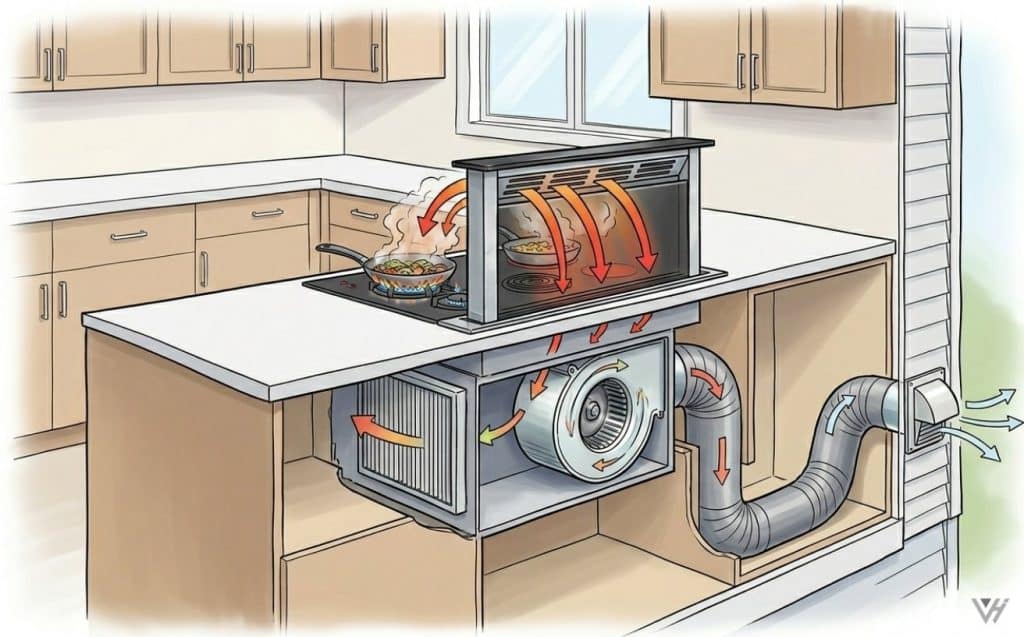
That working-against-convection principle is the one mechanical fact worth understanding before you evaluate any specific model. The fan must generate enough suction to redirect cooking air away from its natural upward path, which has direct implications for how well the unit performs under different cooking conditions.
Types of Downdraft Range Hoods
Not all downdraft kitchen hoods work the same way. There are three configurations you will encounter, and the right one depends on your kitchen layout and how visible you want the ventilation to be.
- A retractable or pop-up downdraft hood rises from the countertop or cooktop surface when in use and retracts flush when you are done cooking. It is the most popular configuration for island kitchens because it disappears completely when not needed.
- An integrated downdraft hood is built directly into the cooktop unit by the manufacturer. The ventilation and the cooking surface are sold as one product, making it the cleanest-looking option available.
- A fixed panel downdraft hood is a permanent raised vent positioned behind the cooktop. It does not retract, is always visible, and is typically the simplest and least expensive configuration to install.
What Kitchen Layout Does a Downdraft Range Hood Actually Need?
A downdraft kitchen range hood is built around a specific set of layout constraints. Knowing whether your kitchen matches those constraints is the most useful thing you can do before comparing models.

It suits island cooktops where an overhead hood is not structurally practical or visually wanted. Island range hoods require ceiling mounting and duct routing through the ceiling cavity. A downdraft routes ductwork under the floor instead, which is a practical advantage in kitchens where ceiling installation creates problems.
It also fits minimalist and open-concept kitchens where a chimney hood above the cooktop would break the sightline between the cooking zone and the living or dining area. A retractable downdraft that disappears when not in use is the only ventilation type that preserves that open visual completely.
Cooktops near windows are another common application. A wall mount hood cannot anchor to glass, and a ceiling-mounted island hood would block the view. A downdraft solves both problems without touching the wall or ceiling above the cooktop.
If your cooktop is against a wall with standard overhead options available, a downdraft is not the right type. A wall mount or under cabinet hood will outperform it at the same price point. For island cooktop owners, the choice between a downdraft and an overhead island hood comes down to how much you are willing to trade ventilation performance for a cleaner visual outcome.
The Kitchens Where a Downdraft Works and the Ones Where It Does Not
A downdraft range hood fits a specific kitchen well and the wrong kitchen poorly. Here is the direct fit check.
A downdraft range hood earns its place in island kitchens where ceiling duct routing is impractical or where the visual presence of a suspended overhead hood conflicts with the room’s design. Electric and induction cooktops at moderate cooking intensity are the strongest match for what this type can reliably deliver.
High-heat gas cooking, frequent frying, and high-BTU burner output push past what a downdraft handles well. Cooktops positioned against a wall with overhead cabinet or wall space available have better-performing options at every price point, and choosing a downdraft in that layout trades ventilation effectiveness for an aesthetic benefit the layout does not require.
If your cooktop is on an island and ventilation performance matters more than aesthetics, an island range hood delivers stronger capture for the same installation footprint. It is worth comparing both before committing.
Related Reading: How to Choose the Right Range Hood for Your Kitchen
FAQs
Is a downdraft range hood as effective as an overhead range hood?
Not under equivalent conditions. An overhead hood captures air as it naturally rises. A downdraft works against that movement and needs more fan power to achieve the same capture rate. For moderate cooking on electric or induction, the gap is manageable. For high-heat gas cooking, it is significant.
Can a downdraft range hood handle gas cooking?
It handles light to moderate gas cooking at lower heat settings. High-BTU burners at full output, frequent frying, and wok cooking push it past its effective range. If gas cooking at high heat is a regular part of how you cook, an overhead hood is the better fit.
Is exterior venting required for a downdraft range hood?
No, though ducted is the stronger-performing option. Ducted downdraft models push captured air outside through ductwork routed under the floor or through the cabinet base. Ductless models pass the air through charcoal filters and return it to the kitchen, which is a workable setup for light cooking where running a duct beneath the floor is not practical.