
If you keep coming across the term “ducted range hood” while shopping for kitchen ventilation and are not sure what it means, this guide gives you a clear answer. We cover everything you need to know about what a ducted range hood is, how it works, and whether it fits your kitchen before you spend a dollar.
What a Ducted Range Hood Actually Is
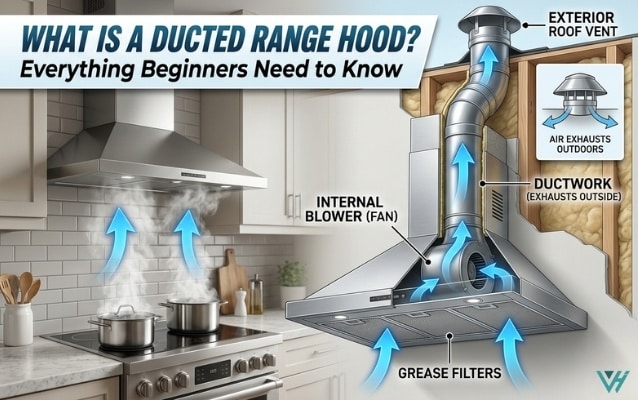
A ducted range hood is a kitchen ventilation appliance mounted above your cooktop that pulls smoke, steam, grease, and heat upward and exhausts it completely outside your home through a duct. That duct is a rigid metal pipe running from the hood through your wall or ceiling to an exterior wall, soffit, or roofline.
The air leaves the building. It does not come back.
Everything the hood captures, including cooking odors, airborne grease, moisture, and combustion byproducts from gas burners, is physically removed from your kitchen rather than filtered and returned.
How a Ducted Range Hood Works
The process starts the moment you turn the unit on. The fan draws rising cooking air up into the canopy. That air passes through the grease filter, where greasy particles are trapped on the filter surface. The fan pushes the air into the duct. It travels through the duct and exits the building through an exterior cap. A damper flap closes when the hood is off, sealing the duct against drafts and pests.
The process repeats for the full length of the cooking session.
If you want to understand the full ventilation cycle, our How Does a Range Hood Work guide covers it in detail
The Parts of a Ducted Range Hood You Should Know
- Canopy: The hood body that sits above the cooktop and creates the capture zone. The wider and deeper it is, the more of the cooking plume it intercepts before it spreads into the room.
- Grease filters: Baffle or mesh panels that catch grease particles as air moves through them. They are washable and reusable. The cleaning schedule is every one to three months.
- Fan or blower: The motor that moves air through the hood and into the duct. Power is rated in CFM, cubic feet per minute. The higher the CFM, the more air the hood moves.
- Ductwork: The rigid metal pipe that carries air from the hood to the exterior. The shorter and straighter the run, the better the airflow.
- Damper: A flap inside the duct that opens when the fan runs and closes when it stops, keeping outside air and pests out of the duct when the hood is not in use.
- Exterior cap: Covers the duct exit on the outside of the building and protects against weather while allowing exhaust air to flow out freely.
Check Our Range Hood Components Guide that covers each part in full detail, including what to check when something stops working.
Why a Ducted Range Hood Performs Better Than Ductless
Because the air leaves the building entirely, a ducted range hood removes more than a ductless system can. Heat and humidity clear out of the kitchen rather than building up. There are no charcoal filters to saturate and no odor control that degrades over time. The system performs consistently as long as the duct path is clean and the grease filters are washed on schedule.

For gas range cooking, this matters beyond comfort. Gas burners produce carbon monoxide and nitrogen dioxide as combustion byproducts. At high BTU outputs, these accumulate faster than a recirculating system can manage. Ducted ventilation removes them continuously while the burners are on.
What a Ducted Range Hood Requires to Install
1. A Clear Duct Path
The duct needs a route from the hood to an exterior exit. In a home with an exterior wall behind the range, that path is short and simple. In upper-floor kitchens or interior wall layouts, the route may require running duct through walls or ceiling plenums, which adds cost and complexity.
2. The Right Duct Diameter
Most residential hoods need 6-inch round duct. Higher-CFM models may require 7-inch or 8-inch. Undersized duct creates back-pressure, strains the motor, and reduces actual airflow at the hood.
3. An Exterior Exit Point
The duct must terminate outside the building at a wall, soffit, or roof. A wall exit is the simplest. A roof exit is the most complex and requires a grease-rated cap.
4. Professional Installation for new Duct Runs
Replacing an existing ducted hood in the same position is often a manageable DIY project. Running a new duct path through walls or ceilings is a construction task most homeowners hire out.
Is a Ducted Range Hood Right for Your Kitchen?
A ducted range hood makes sense when your kitchen can support one. If you own your home, there is a workable duct path to an exterior exit, and you cook with any regularity, ducted ventilation is worth the upfront investment. It performs better, costs less to maintain over time, and adds real value to the home.
If you rent, if your building prohibits structural modifications, or if there is no practical duct path available, a ducted range hood is not a workable option regardless of its performance advantage. In those cases, a ductless hood is the appropriate choice. See our ducted vs ductless range hood comparison for a full side-by-side comparison of both types across cost, installation, and performance.
If you are ready to get a new one, our best ducted range hoods guide covers the top-rated models across every budget and kitchen type.
Is a Ducted Range Hood the Same as a Vented Range Hood?
Yes. Ducted, vented, and externally vented all mean the same thing: the hood exhausts air outside through a duct. Manufacturers and retailers use all three terms interchangeably. If a product listing says “vented” or “externally vented,” it is ducted.
Can a Ducted Range Hood Work Without Ductwork?
No. A ducted range hood needs an actual duct path to function as designed. Without ductwork, there is nowhere for the captured air to go.
Some models are sold as convertible, meaning they can be configured for either ducted or ductless operation. A convertible hood installed without ductwork runs in ductless mode and performs accordingly. The ducted performance only applies once a duct path is in place. If you plan to add ductwork later, a convertible model keeps that option open from day one.
Ready to go further? Check These Guides Out: