

A range hood is one of the hardest-working appliances in the kitchen. It pulls smoke, grease, steam, and cooking odors out of the air before they settle on surfaces, cabinetry, and walls. Without adequate ventilation, those contaminants accumulate over time, affecting indoor air quality and leaving persistent odors that spread throughout the home.
Despite that, range hoods are frequently selected last in a kitchen build or renovation, treated as an afterthought rather than a functional priority. The result is often a hood that does not match the cooktop size, lacks sufficient airflow, or creates installation problems that are costly to correct.
Understanding the different types of range hoods before you buy is the most reliable way to avoid those mistakes. Here we will cover every major type by installation style, ventilation method, and design aesthetic, along with practical guidance on filters and how to match the right hood to your kitchen. Let’s start with installation style.
Main Types of Range Hoods (By Installation Style)
Installation style is the most practical starting point when evaluating range hood types. It determines where the hood sits in the kitchen, how it connects to the cooking surface below, and what structural requirements need to be met before installation. The right type depends on kitchen layout, cabinet configuration, and venting access — not aesthetic preference alone.
1. Under-Cabinet Range Hoods
Under-cabinet range hoods mount directly to the underside of a cabinet positioned above the cooktop. The cabinet provides the structural support, and the hood sits flush against it, keeping the overall profile low and compact.
This is the most common vent hood installation type in residential kitchens and the most widely available option across all price ranges. Under-cabinet hoods work well in standard kitchen layouts where space is limited and cabinetry runs directly above the range.

Best for: Small to medium kitchens with standard upper cabinetry above the cooktop.
Pros
Cons
2. Wall-Mounted (Chimney) Range Hoods
Wall-mounted range hoods attach directly to the wall above the cooktop and extend upward toward the ceiling through a chimney-style duct cover. No overhead cabinet is required. The hood is anchored to the wall, and the chimney section conceals the ductwork running to the exterior.
This style is a common choice in kitchen renovations where upper cabinetry has been removed in favor of open shelving or a clean wall treatment. Wall-mounted hoods are available in a wide range of finishes, including brushed stainless, matte black, and custom-painted options, and they often serve as a visual focal point above the range.

Best for: Kitchens without upper cabinetry above the range, open-concept layouts, and kitchens where the hood is intended to contribute to the overall design.
Pros
Cons
3. Island Range Hoods
Island range hoods are ceiling-mounted units designed specifically for cooktops positioned on a kitchen island, away from any wall. Because there is no wall for structural support or ductwork routing, the hood is suspended from the ceiling and vented through a duct run concealed within the ceiling structure or a decorative chimney column.
Island hoods require careful planning before selection. The ceiling must be capable of supporting the hood’s weight, and the duct path from ceiling to exterior must be mapped before the hood is purchased. CFM requirements are also higher for island installations because the open configuration allows rising air to escape on all four sides of the cooking surface.

Best for: Open-plan kitchens with island cooktops and ceiling heights of nine feet or more.
Pros
Cons
4. Insert (Built-In) Range Hoods
Insert range hoods, also called liner hoods, are motor and blower units designed to be installed inside a custom cabinetry surround or a decorative hood shell. The insert itself is not visible in the finished kitchen. It sits within the cabinetry or plaster structure, and the external material provides the finished appearance.
This configuration is common in high-end custom kitchens where a specific design is required and no standard product matches it. The homeowner or designer specifies the external appearance of the hood surround, and the insert provides the ventilation function from inside.
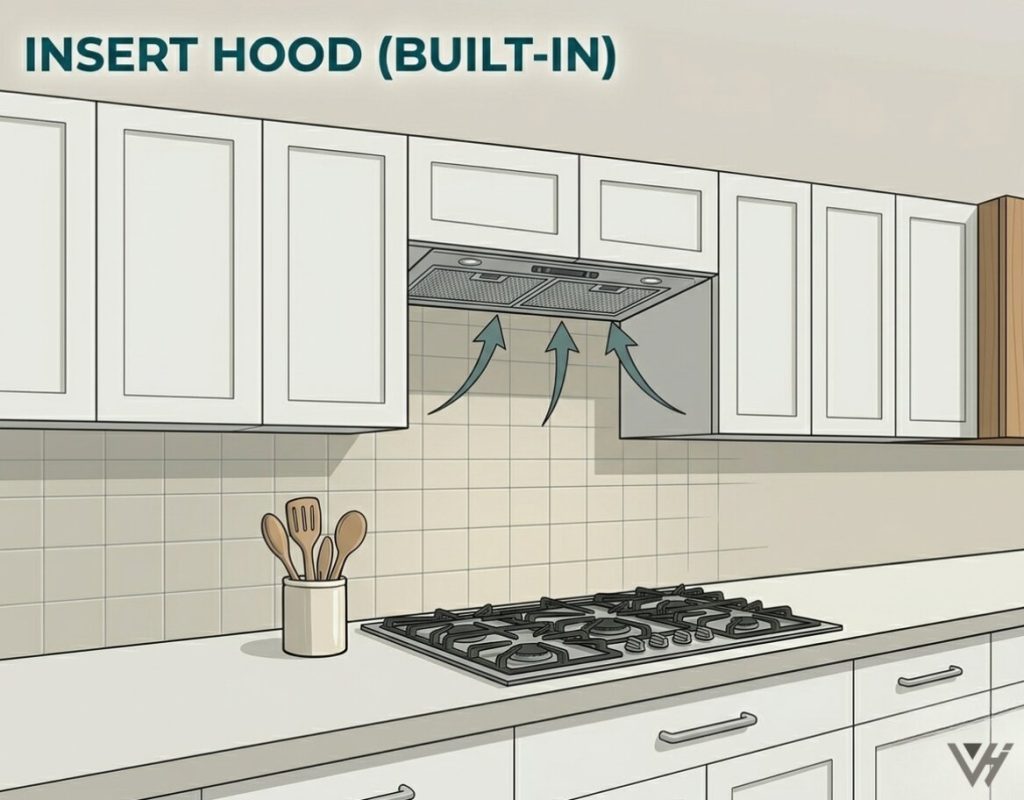
Best for: Custom kitchen builds, remodels with a specific design requirement, and kitchens with a dedicated decorative hood surround.
Pros
Cons
5. Downdraft Range Hoods
Downdraft ventilation systems are built into or mounted behind the cooktop rather than above it. Instead of capturing rising smoke and steam from overhead, a downdraft system pulls air downward and exhausts it through ductwork running beneath the floor or behind the range wall.
This approach is used in kitchens where overhead ventilation is not possible, typically in open-plan spaces, kitchens with vaulted or cathedral ceilings, or island installations where a ceiling-mounted hood is not desired. The trade-off is ventilation efficiency. Because smoke and steam naturally rise, pulling them downward requires more mechanical effort and typically yields less effective results than an overhead hood at the same CFM rating.

Best for: Kitchens where overhead installation is not feasible, and cooking styles that produce moderate smoke and steam rather than heavy cooking loads.
Pros
Cons
Types of Kitchen Hoods by Ventilation Method
Installation style determines where the hood goes. Ventilation method determines how it works. Every range hood, regardless of installation style, operates as either a ducted system that vents air to the exterior or a ductless system that filters and recirculates air back into the kitchen.
1. Ducted (Vented) Range Hoods
Ducted range hoods pull air through the hood, pass it through a grease filter, and exhaust it outside the home through a duct system. The air, along with smoke, steam, grease particles, and odors, exits the building entirely rather than being returned to the kitchen.
This is the more effective ventilation method. Because contaminated air is removed from the kitchen rather than filtered and returned, ducted hoods perform better for heavy cooking, gas cooktops, and any kitchen where air quality is a priority. They require a duct path to the exterior, which limits installation flexibility in some homes.
Ducted hoods are available across a wide CFM range, from around 200 CFM for basic under-cabinet models to over 1,200 CFM for professional-grade wall-mount and island units.
Best for: Gas cooktops, heavy or frequent cooking, and kitchens with existing duct access or the structural ability to add it.
2. Ductless (Recirculating) Range Hoods
Ductless range hoods do not vent air to the exterior. Instead, they pull air through a grease filter, pass it through a charcoal filter to absorb odors, and return the cleaned air to the kitchen. No ductwork or exterior wall penetration is required.
This makes ductless hoods significantly easier to install in apartments, rental properties, and kitchens where exterior venting is not structurally possible. The limitation is performance. Charcoal filters absorb odors but do not remove heat or moisture from the kitchen. The filters also require regular replacement, typically every three to six months depending on cooking frequency, which adds to the long-term operating cost.
Ductless hoods are suitable for light to moderate cooking on electric or induction cooktops. For gas ranges or kitchens with frequent high-heat cooking, a ducted system is the recommended choice.
Best for: Apartments, rental units, and kitchens where exterior duct installation is not feasible.
Different Types of Range Hoods by Design and Style
Beyond installation and ventilation method, range hoods differ significantly in design aesthetic. The style of hood affects the visual character of the kitchen as much as any other design decision. The right choice depends on the overall kitchen design, cabinetry style, and how much visual prominence the hood is intended to carry.
1. Traditional Range Hoods
Traditional range hoods feature decorative detailing including corbels, crown molding, raised panels, and curved profiles. They are most commonly finished in painted wood or plaster, though stainless steel versions with traditional profiles are available.
This style suits kitchens with classic cabinetry, furniture-style islands, and farmhouse or craftsman design themes. Traditional hoods are often custom-built or selected as a deliberate focal point above a professional-style range.
Common materials: Painted MDF, solid wood, plaster, copper
2. Modern and Contemporary Range Hoods
Modern range hoods prioritize clean lines, minimal surface detail, and flat profiles. Glass canopies, brushed stainless steel, and matte black finishes are common. The hood profile is typically angular, designed to complement rather than dominate the kitchen.
Contemporary hoods suit open-plan kitchens, kitchens with flat-panel cabinetry, and spaces where the design goal is visual restraint. Touch controls and LED lighting are standard features on most models in this category.
Common materials: Brushed stainless steel, tempered glass, matte black powder coat
3. Custom Range Hoods
Custom range hoods are designed and fabricated to specification in any material, finish, or shape required. Wood, plaster, stone, copper, and painted finishes are all options. Custom hoods can be integrated seamlessly with surrounding cabinetry or built as a standalone architectural feature in the kitchen.
This approach is chosen in high-end kitchen builds where standard product dimensions or finishes do not meet the design requirement. A custom external hood shell is typically paired with an insert to provide the ventilation function.
Best for: Custom kitchen builds, unique architectural spaces, and kitchens where no standard product meets the design requirement.
4. Professional (Commercial-Style) Range Hoods
Professional-style range hoods are designed for residential kitchens but built to perform closer to commercial standards. They feature high CFM ratings, typically 600 to 1,200 CFM or more, heavy-gauge stainless steel construction, baffle filters, and powerful blower systems.
These hoods are most commonly paired with professional-style gas ranges. The higher airflow capacity is necessary to handle the heat output and combustion byproducts from high-BTU commercial-style burners, which can exceed 15,000 BTU per burner on residential models and significantly more on true commercial equipment.
Best for: High-heat cooking, commercial-style gas ranges, and kitchens that handle frequent high-volume cooking.
How to Choose the Right Type of Range Hood for Your Kitchen
The right range hood comes down to four factors: kitchen layout, cooking habits, budget, and installation constraints. We find that most buying mistakes happen when appearance is prioritized first; the hood looks appropriate but quietly underperforms every time it is used.
By Kitchen Layout:
Layout is the first filter you need to apply because it immediately removes options that simply will not work. Under-cabinet hoods suit small kitchens with existing cabinetry; they install within the structure already in place and add no visual bulk. Wall-mount hoods work where the range sits against a wall with no overhead cabinets above it, and we consider these the most versatile option for mid-size and open kitchens. Island hoods are not optional when the cooktop sits on a kitchen island; they are the only type designed to capture rising air from all four sides without a wall or cabinet to contain it.
By Cooking Habits:
CFM requirements are where we see the most consistent undersizing. Light cooking on electric or induction cooktops is adequately handled by 200-400 CFM. Regular household cooking calls for 400-600 CFM ducted; we recommend erring toward the higher end in open-plan kitchens, since containment is harder without walls limiting airflow spread. High-BTU gas ranges require a minimum of 600 CFM, with professional-style hoods reaching 900-1,200 CFM for commercial-style ranges. In our experience, undersizing here produces visible smoke and persistent odor regardless of how well the filters are maintained.
By Budget:
Budget shapes the field considerably, though we would caution against treating the entry-level tier as a long-term solution for a primary kitchen. Entry-level hoods ($100–$300) suit light use and temporary setups. Mid-range hoods ($300–$700) bring baffle filters, variable fan speeds, and LED lighting; we consider this the sweet spot for most everyday household kitchens. Premium hoods ($700–$2,000+) deliver high CFM output, low sone levels, and quality finishes; in our view, this tier is worth the investment for serious home cooks and design-forward kitchens.
By Installation Constraints
Installation constraints deserve more attention than most buyers give them before purchase, and we find this is where avoidable problems tend to originate. No exterior duct path means a ductless hood is the only viable option; factor in ongoing charcoal filter replacement from the start.
No overhead cabinetry opens the door to wall-mount hoods, which we prefer in this situation for their CFM flexibility over under-cabinet models. A cooktop on a kitchen island requires an island hood without exception; we strongly recommend confirming ceiling support and duct access before selecting a model.
We recommend working through these four factors in order before settling on a style. Layout and installation constraints alone will eliminate most incompatible options before budget even becomes a consideration.
For a detailed breakdown of CFM sizing, sone ratings, and duct sizing, read our complete guide on how to choose a range hood that actually fits your kitchen.
Final Thoughts
The different types of range hoods exist because kitchens are not all built the same way. Under-cabinet, wall-mount, island, insert, and downdraft each solve a specific layout problem, and the right one is simply whichever type fits the cooktop position, the available installation path, and the daily cooking load. A ducted system is preferred wherever exterior venting is possible. In our view, a hood chosen on those three criteria will consistently outperform a visually impressive model that ignores them.
Frequently Asked Questions
Which type of range hood is best for beginners?
An under-cabinet ducted range hood is the most practical starting point. It installs easily in most existing kitchens without significant modification, is available across all price points, and performs well for standard household cooking.
What is the most effective type of range hood?
A ducted wall-mount or island hood with a CFM rating matched to the cooktop output provides the most effective ventilation. Ducted systems remove air from the kitchen entirely rather than filtering and recirculating it, which produces better results for smoke, odor, and moisture control.
Are ductless range hoods effective?
Ductless range hoods are effective for light to moderate cooking in kitchens where exterior venting is not possible. They capture grease and reduce odors through charcoal filtration. They do not remove heat or moisture from the kitchen, and they require regular filter replacement to maintain performance over time.
What size range hood do I need?
The hood should be at least as wide as the cooktop. For gas ranges or high-BTU burners, sizing up by three to six inches on each side provides better capture of rising smoke and steam. A 30-inch cooktop pairs with a 30-inch minimum hood, though a 36-inch hood is the preferred choice for better coverage.
How much CFM do I need for my kitchen?
A general guideline is 100 CFM per 10,000 BTU of gas burner output. For electric and induction cooktops, 100 CFM per linear foot of cooktop width is a reasonable starting point. Open-plan kitchens and island installations typically require higher CFM to compensate for rising air escaping on open sides.
What type of range hood is best for an island cooktop?
An island range hood is the purpose-built option for cooktops positioned on a kitchen island. It mounts from the ceiling and is designed to capture airflow on all four sides of the cooking surface. A downdraft system is a practical alternative if ceiling installation is not structurally feasible.
What is the difference between a ducted and ductless range hood?
A ducted range hood vents air outside the home through a duct system, removing smoke, grease, odors, and moisture entirely. A ductless range hood filters the air through grease and charcoal filters and returns it to the kitchen. Ducted hoods perform better overall. Ductless hoods are used where exterior venting is not available.
Read Related Articles: