
Not every kitchen can support ductwork. If you rent, live in an apartment, or simply have no exterior wall access near your range, a ductless range hood is likely your most practical option. Here is what it is, how it works, and what to expect from it before you buy.
What a Ductless Range Hood Actually Is
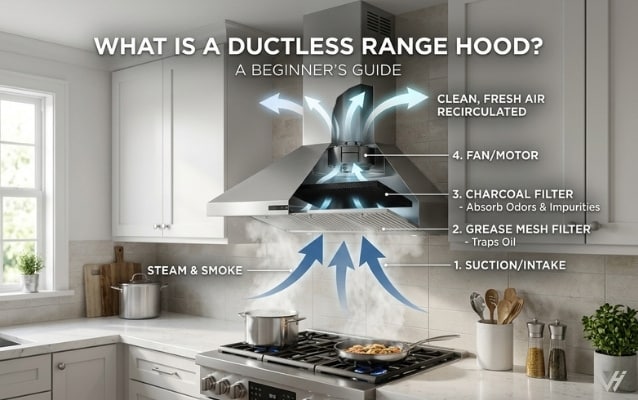
A ductless range hood, also called a recirculating range hood, mounts above your cooktop and pulls in cooking air, smoke, and steam. Instead of exhausting that air outside through a duct, it passes the air through a set of filters and returns it to the kitchen.
There is no pipe running through the wall. No exterior exit. The hood filters what it captures and recirculates it back into the room.
The air stays inside your home. What changes is how much of the smoke, grease, and odor has been removed before it comes back.
How a Ductless Range Hood Works
Switch the hood on and rising smoke and steam are pulled up into the canopy. It moves first through the grease filter, which catches greasy particles before they can reach the charcoal layer. It then passes through the charcoal filter, which absorbs odor molecules. The fan returns the filtered air back into the kitchen through vents in the top or front of the hood.
The loop runs without interruption for as long as you are cooking.
Our How Does a Range Hood Work guide covers the full ventilation cycle in detail, including how ducted and ductless systems compare at each stage.
The Parts of a Ductless Range You Should Know
- Canopy: The hood body mounted above the cooktop. Creates the capture zone that draws rising air upward into the filter system.
- Grease filter: Mesh or baffle panels that intercept greasy particles at the first stage of the filter system. Washable and reusable. Plan on cleaning them every one to three months, more frequently if you cook at high heat regularly.
- Charcoal filter: Also called an activated carbon filter. This is the component that absorbs cooking odors. It cannot be cleaned and must be replaced every three to six months depending on how often you cook.
- Fan or blower: The motor that pulls air through both filters and returns it to the kitchen. CFM measures how much air it moves per minute.
Our Range Hood Components Guide covers every part in detail, including how each one affects how well your hood performs.
The Charcoal Filter: What Every Ductless Hood Owner Needs to Know
The charcoal filter is what makes a ductless range hood work and what determines how long it keeps working.
Activated charcoal absorbs odor molecules as air passes through its porous surface. When the filter is fresh, it handles everyday cooking odors well. The issue is capacity. Once those porous surfaces are full, the filter stops absorbing and starts passing odors straight through. The hood keeps running, but odor control is effectively gone.

Replacement is not optional. Skip it and the ductless range hood stops doing most of what it is supposed to do. The clearest sign the filter needs replacing: cooking smells that linger in your kitchen after the hood has been on.
What a Ductless Range Hood Requires to Install
- A power source: A standard electrical connection near the mounting location. Most models run on standard 120V household current.
- Correct clearance height: 24 to 30 inches above an electric cooktop, 28 to 36 inches above gas. Too low risks heat damage to the unit. Too high reduces how effectively it captures the cooking plume.
- No ductwork or exterior access: This is the practical advantage. No wall penetrations, no duct pipe, no permits in most jurisdictions. A ductless range hood can be installed in apartments, rentals, and condos where structural modifications are not permitted.
- A filter replacement schedule: Not an installation step, but a real commitment. Budget for charcoal filter replacements every three to six months and follow through on the schedule.
What a Ductless Range Hood Does Well and Where It Falls Short
For everyday cooking, pasta, vegetables, eggs, reheating, a ductless range hood with fresh filters does its job. Visible smoke reduces. Odors are absorbed to the degree the charcoal filter has remaining capacity. The air is not expelled to the exterior, so cooking heat and humidity build up in the room rather than clearing out.
Where it falls short is under heavy, sustained cooking. Deep frying, wok cooking, indoor grilling, and cooking with strong aromatics push the charcoal filter to its limit quickly. Heat and humidity also remain in the kitchen, which becomes noticeable over a long cooking session.
If heavy cooking is your routine and your kitchen can support ductwork, a ducted hood is the stronger specification. If installation constraints make that impractical, a well-maintained ductless range hood is a legitimate solution. For a full side-by-side breakdown of both types, our ductless vs ducted range hood comparison covers performance, cost, installation, and maintenance in detail.
Are Convertible and Ductless Range Hoods the Same Thing?
No. A convertible range hood is a model that can be configured for either ducted or ductless operation at installation. A ductless range hood is any hood operating without a duct connection, recirculating filtered air back into the kitchen.
The overlap is that a convertible hood running in ductless mode is functioning as a ductless hood at that point. But the terms describe different things. Convertible describes the hood’s capability. Ductless describes its operating mode.
A ductless-only hood is designed purely for recirculating use and cannot be converted to ducted. A convertible model can switch to ducted later if you install ductwork. If there is any chance your situation will change, renting now and planning to own later, a convertible model is worth the consideration over a ductless-only unit.
Can a Ductless Range Hood Be Converted to Ducted?
Only if the model is sold as convertible. Convertible hoods include the hardware needed to switch between modes. Buy one and later install ductwork, and the conversion is a cup of tea.
Ductless-only models are not built for conversion. If keeping that option open matters to you, check the product specs before you buy.
Does a Ductless Range Hood Actually Work?
Yes, within its design limits. A quality ductless range hood with fresh filters reduces visible smoke, absorbs cooking odors, and catches grease at the filter level. For moderate cooking, the difference it makes is real. If you are ready to choose a model, our best ductless range hoods guide covers the top-rated options across apartments, rentals, and budget-conscious kitchens.
What it does not do is match a ducted hood on raw performance. The air stays in the kitchen. Odor control degrades between filter replacements. Heavy cooking exceeds what the filter system can fully manage.
A maintained ductless range hood used for the right cooking load works well. An unmaintained one, or one pushed beyond its design limits, will not.
Read Further: